
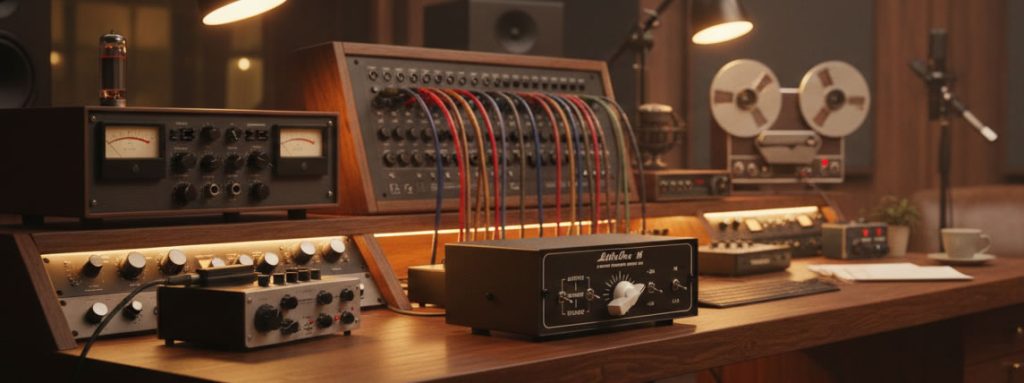
Desktop Passive Summing Mixers – Analog Summing for Hybrid Studios
Every VintageMaker desktop passive summing mixer is handcrafted and custom-calibrated to your specific audio interface, delivering wider stereo imaging, greater mix headroom, and the three-dimensional analog depth that digital summing alone cannot replicate.
Why VintageMaker?
Designed for engineers, producers, and mastering studios who need more than generic analog hardware. At the core of every unit is a Floating Differential Bus Summing Network – a fully balanced, isolated-ground topology that preserves stereo separation and phase-coherent channel interaction. Since passive summing attenuates the signal (typically 5–25 dB), your existing mic preamps serve as makeup gain stages – letting you choose the final tonal character of your mix chain. No generic boxes. No compromises. Built for your setup.

Compare Desktop Passive Summing Mixer Configurations
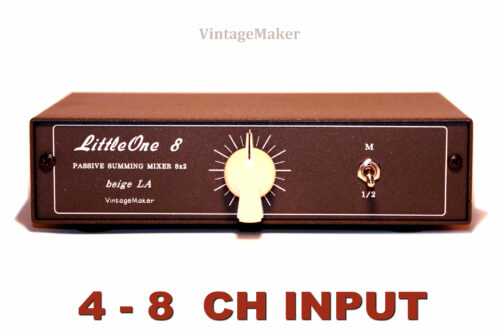

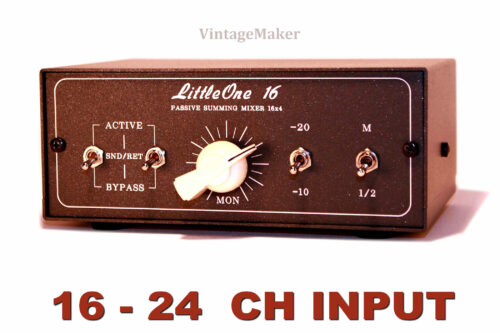
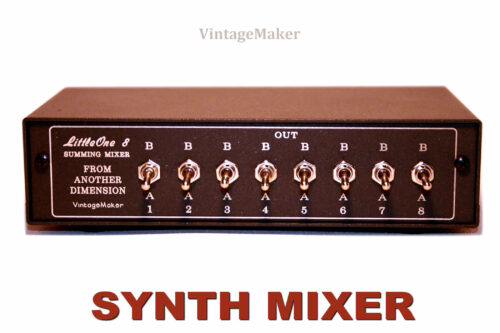
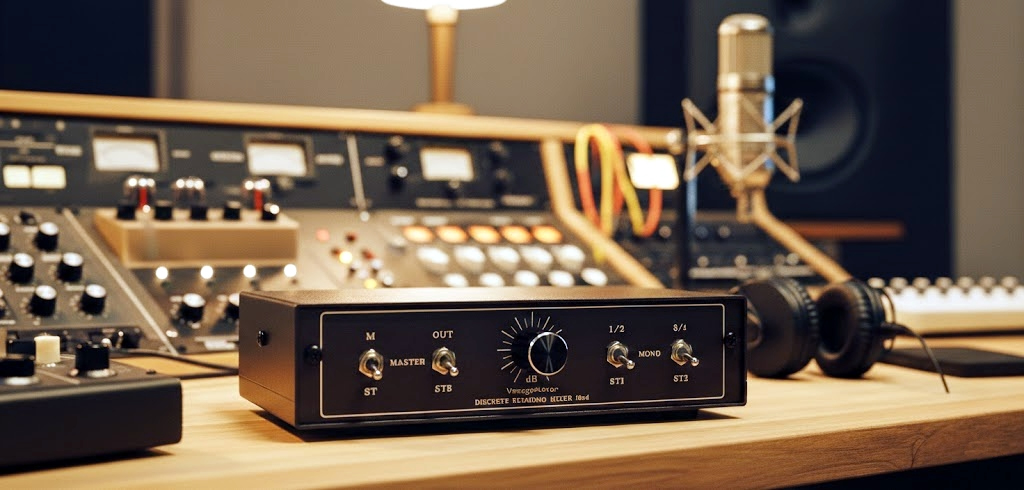
7 Benefits of Using a Desktop Passive Summing Mixer
⦁ Enhanced Stereo Imaging – Real voltage interaction between channels can improve perceived width and instrument separation within the stereo field.
⦁ Greater Depth and Dimension – Voltage-domain summing introduces subtle harmonic interaction and level-dependent behavior, contributing to a more three-dimensional sense of space.
⦁ Improved Headroom Behavior – Analog circuitry operates beyond nominal level before hard clipping occurs, allowing transients to pass more naturally compared to a fixed 0 dBFS ceiling.
⦁ Phase-Coherent Summing – A precision resistor network maintains stable phase relationships between channels, supporting punch, clarity, and mix cohesion.
⦁ Clean, Transparent Signal Path – High-tolerance, precision-selected resistors sum signals with extremely low noise while preserving balanced signal integrity.
⦁ Flexible Hybrid Integration – Easily connects to DAW outputs, professional audio interfaces, hardware synthesizers, modular systems, and drum machines.
⦁ Custom Calibration to Your Studio – Each unit is individually built and calibrated to match your specific audio interface output levels and outboard chain, ensuring correct attenuation, predictable gain staging, and optimal headroom within your setup.
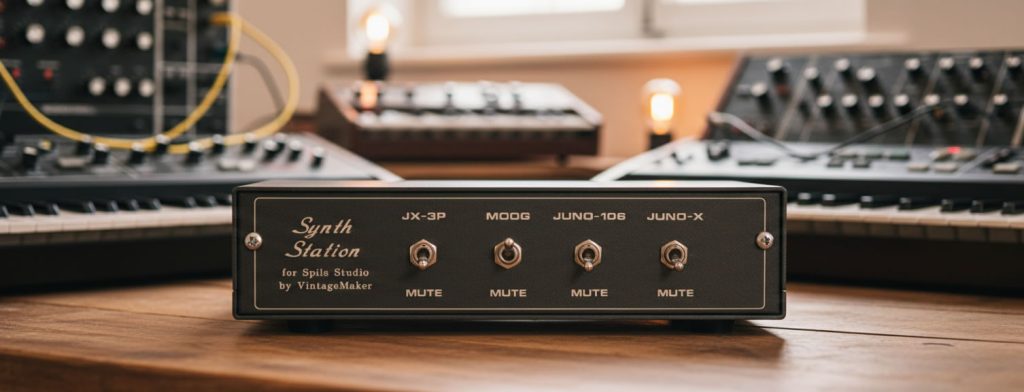
Pro Tip
Drive your stems slightly hotter into the summing inputs while maintaining proper gain staging. As the passive network and subsequent amplification stages approach their operating range, subtle harmonic saturation and gentle peak rounding may occur. This controlled analog behavior can enhance perceived warmth, depth, and separation while preserving dynamic clarity through extended headroom.
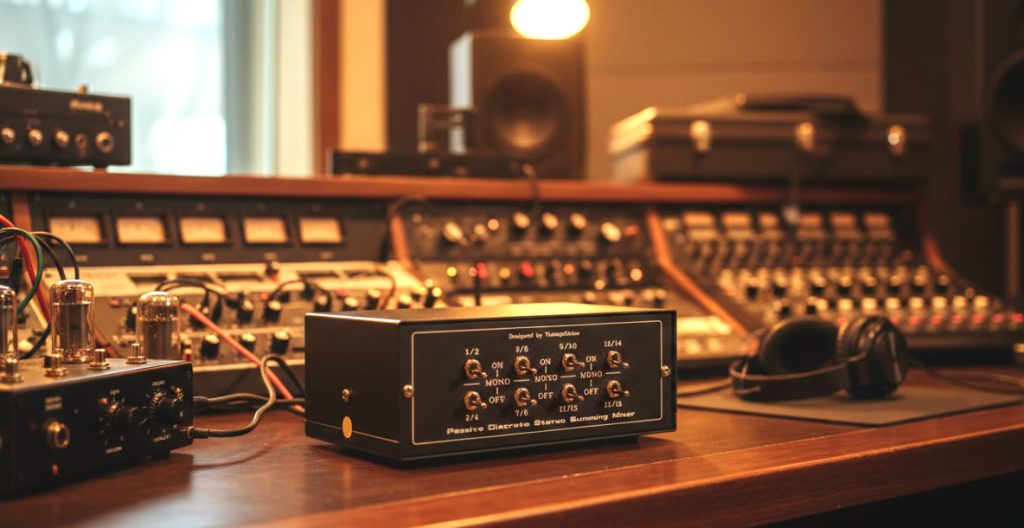
What Users and Engineers Say
“Sounds Like a Record”
“Just a quick note to say how pleased I am with this summing mixer. I summed a piano session and a jazz session, and all I can say is that it makes things sound finalized – like a sonic glue. There is definitely a stability it adds. It sounds like a record.”
— Alex Brendford
Clarity, Width, and True 3D Depth
“If your tracking chain is solid but your mixes sound muddy, boxy, thin, or narrow compared to larger productions, this made a clear difference for me. My mixes became clearer and wider, with improved instrument separation and focus. I also noticed I’m using less outboard gear and fewer plugins. The unit is extremely quiet.”
— Bernie Becker
From Dangerous D-Box to LittleOne 16
“A few years ago I owned a Dangerous D-Box. Recently I returned to mixing and tried the LittleOne 16. I immediately noticed additional roundness and depth. I could hear more detail in reverb tails, which helped finalize my mixes. The flexibility is excellent – I can run the output through different preamps to choose the coloration I want.”
— Peter Cruz
Affordable, Flexible and Wide
“Thank you, Paul. I bought the LittleOne 10 with multiple stereo-to-mono switches and connected it to my PreSonus Studio 192. Wow — excellent sound. Wide, loud, and much clearer. For the price, you simply can’t beat it.”
— Fredrik Norton

When a Summing Mixer Is Not Needed
Single stereo (1L/1R) sessions do not benefit from passive summing. Analog summing begins to show both measurable and audible interaction when multiple channels are combined – typically four or more.
With only a single stereo track, there is no inter-channel summing interaction, no shared bus behavior, and no cumulative harmonic contribution. The mechanisms that define analog summing are simply not engaged.
For single-source sessions, a high-quality transformer-based color amplifier (for example, Neumann- or Filtek/SSL-style designs) may be a more appropriate tool for adding harmonic richness and dimensional character to individual signals.

Frequently Asked Questions – Desktop Passive Summing
What is a passive summing mixer and how does it work?
A passive summing mixer combines multiple balanced audio channels into a stereo mix using only precision resistors and balanced wiring, with no active electronics or power supply. The resistor network defines attenuation, impedance behavior, and available headroom, while overall system noise depends on source quality, cabling, grounding, and the external makeup gain stage.
How much signal attenuation should I expect?
Passive summing attenuate the combined signal typically between approximately -6 dB and -25 dB depending on configuration and calibration. Makeup gain is restored using external mic preamps or line amplifiers matched to your interface and preferred gain structure.
Which audio interfaces are compatible?
VintageMaker desktop passive summing mixers are compatible with any interface providing balanced outputs and access to balanced mic preamps or suitable gain stages, including RME Fireface, Universal Audio Apollo x16, Antelope Orion, Focusrite Scarlett, Apogee and similar professional systems. Custom calibration ensures predictable operating levels.
Do I need a power supply?
No. Passive summing mixers require no power supply because the signal path consists entirely of resistors and balanced wiring with no internal gain stages. As a result, there is no power-supply related noise contribution from the summing unit itself.
Can I use the summing mixer for stem mixing?
Yes. The desktop configurations support stem-based workflows and many models include stereo-to-mono switches for summing mono sources cleanly to the center while maintaining balanced operation.
What is the Variable Headroom or PAD switch and when should I use it?
The optional Variable Headroom or PAD switch introduces stepped attenuation to provide additional headroom when DAW outputs operate at higher levels. This helps prevent overdriving the downstream makeup gain stage while still allowing controlled harmonic behavior at the summing inputs.
Is there a noise floor issue with passive summing?
A passive resistor network does not introduce active circuit noise. Overall system noise performance depends on signal level, cable quality, grounding integrity, and the noise characteristics of the external gain stage used for makeup amplification.
How do I connect the summing mixer to my DAW?
The standard workflow is DAW outputs to summing mixer inputs via balanced cables, summing mixer stereo output to two mic preamp channels for makeup gain, then back into the audio interface and DAW for capture or print.