
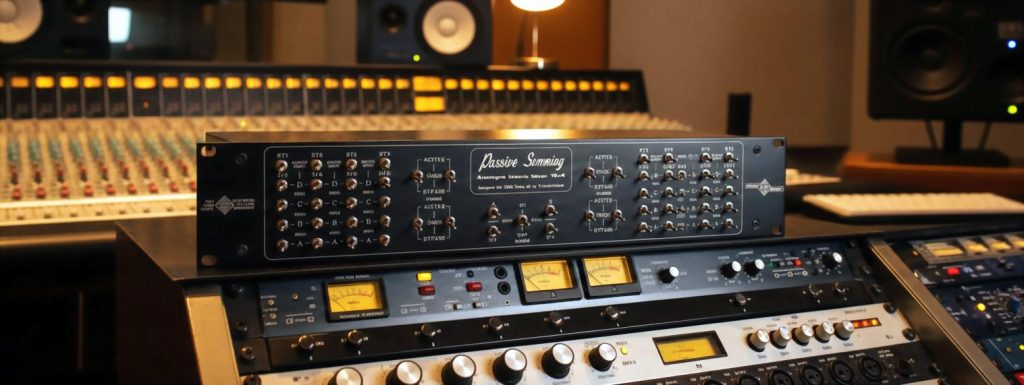
Rackmount Passive Summing Mixer – 1U & 2U, Custom-Built for Your Studio
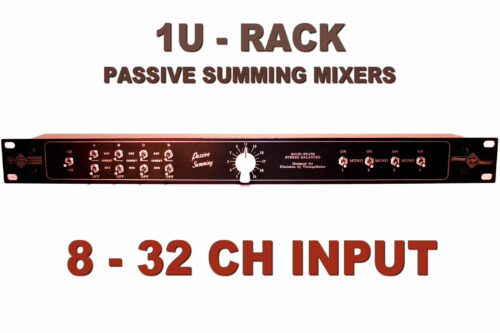
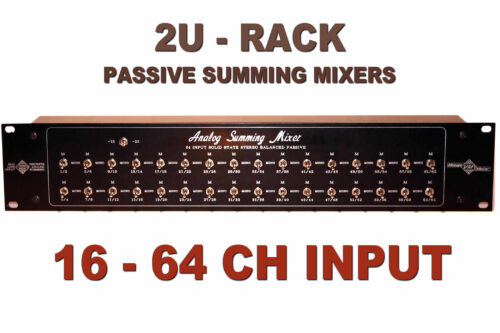
Professional rackmount passive analog summing in 1U and 2U formats. Each unit custom-calibrated to your specific audio interface and preamp gain structure – from 8 to 64 input channels. The same Floating Differential Bus Summing Network at the core of every VintageMaker unit, now scaled for full console-replacement workflows, large hybrid sessions, and mastering chains.
Handcrafted in EU since 2010. Used by Grammy-nominated producers and mastering engineers worldwide. → Read what engineers say
Why Every Unit Is Custom-Built for Your Setup
Most passive summing mixers are built to a generic specification – and that’s exactly the problem. A resistor network that isn’t matched to your preamp’s gain range will either leave headroom on the table or require 50+ dB of gain makeup, the kind only achievable with Neve 1073- or Avalon-class preamps.
That’s why it doesn’t matter whether you’re using a mid-range interface or a budget audio card. Every VintageMaker rackmount passive summing mixer is individually engineered around your specific interface output level and preamp gain structure – so the unit works with what you have, not against it.
Simply provide your interface model and preamp gain range when ordering. Each unit is built and calibrated precisely for your setup, not a generic spec.
| Feature | Generic Passive Summing Box | VintageMaker Custom-Built |
| Calibration | One-size-fits-all gain loss | Matched to your exact interface and preamp |
| Required makeup gain | -35 to -45 dB loss → needs Neve, Avalon | -6 to -25 dB loss → works with any DAW/preamp |
| Noise floor | Depends on your gain recovery | Optimised for your specific preamp working range |
| Channel range | Fixed product SKUs | 8 to 64 ch, any connector combination |
| Build | Mass produced | Hand-built in EU, individually calibrated – tested |
Pro tip: The analog sweet spot is reached when you gently drive the summing inputs above nominal level. This introduces primary harmonic saturation – warmth, depth, and the dimensional character that defines a real analog mix bus. Read more → How Analog Passive Summing Works
Rackmount vs. Desktop – Which Format Do You Need?
Both rackmount and desktop configurations share the same core summing architecture and custom calibration approach. The format choice is practical, not sonic.
| Feature | LittleOne Series (Desktop) | Rackmount Series (1U / 2U) |
|---|---|---|
| Format | Compact desktop, no rack required | Standard 19″ rack (1U or 2U) |
| Channel Range | 4 – 24 channels | 8 – 64 channels |
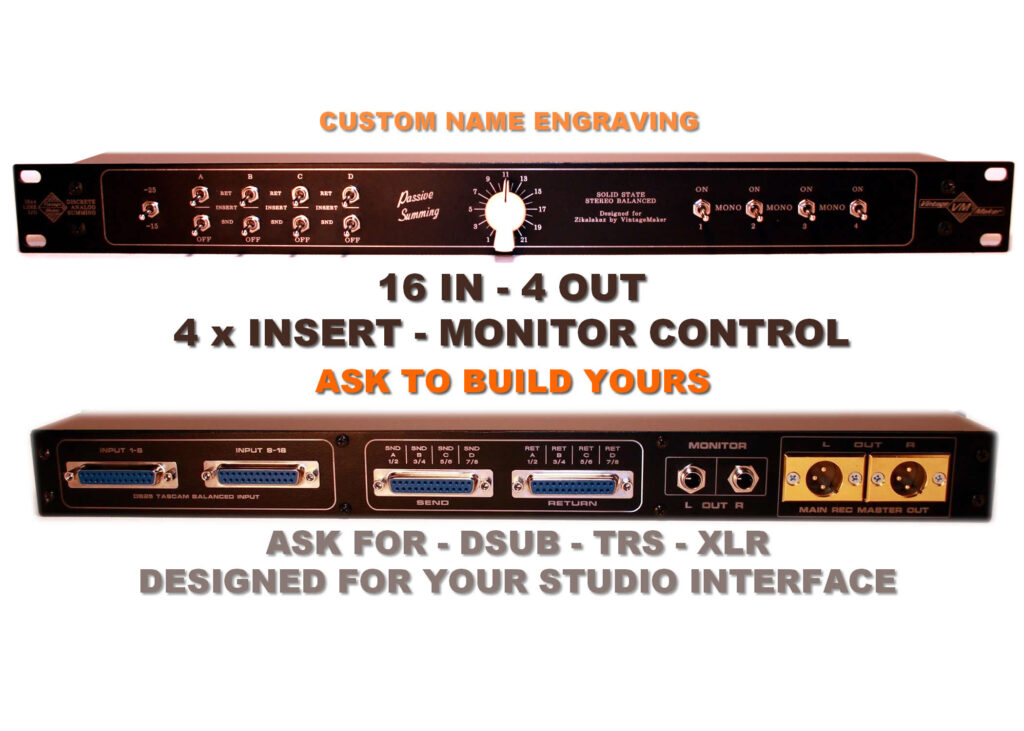
| Typical Connectors | TRS / DSUB | TRS / XLR / DSUB |
| Master Insert | Single stereo insert | Multi-insert (up to 4+ stereo loops) |
| Channel Insert | Limited / basic | Fully customizable (any channel count) |
| Multi-bus Option | No (single stereo bus) | Yes (4-BUS, sub-groups, AUX) |
| Build Type | Space-saving, portable | Rack-mounted studio setup |
What Engineers Say – Customer Reviews
“Things are a lot sweeter! Compared to the previous mixes this overall sound, including the vocal, is like milk and honey! Overall with better balance and natural tonality. The sound has very nice dynamics and impact. It’s a total transformation. Good clarity, instrumental balance, stereo image…” – Bob Katz (mastering engineer, via customer Jeffrey McLaughlin)
“The real deal maker is that you can get a custom built one that suits your exact needs. The international shipping was very fast to the West Coast USA, and the build time was within a week for my specific custom needs. Definitely a great choice!!” — Mike Castonguay, imaginationsurplus.com
“After a few days of tweaking the entire system, the summing is sounding beautiful and my mixes are crisp and full-bodied like never before! Stereo is wide and mono puts a lot of body and punch to the songs.” — Alexandre Ciaglia
“It clearly sounds better than in-the-box summing, but you all knew that would be the case. It also sounds better than the AMEK console that I had been using for summing mixes. A serious upgrade for a box that is reasonably priced for what it does.” — Herb Belofsky, Drummer · Austin, Texas (Gearspace)
“My mixes transformed from trying to fix harsh tones to having to brighten some of the tracks, which is a positive challenge. The 3D stereo imaging is indeed accurate, particularly on effects, and the sweet warm sound of the summing mixer makes me want to listen instead of shying away from piercing guitar solos or female vocals. The transformation of my mixes was well worth the $500 I spent.” — Gearspace reviewer, producer with 15 years of experience
“Really well made. Noiseless, infinite headroom and no power required. The best way to mix outside the computer — enjoy clip-free summing and then use the mic pres of your choice to send your mix back to your DAW. Paul makes some amazing high quality summing mixers. I’ve owned the Dangerous 2 Buss and the Folcrom, and this easily holds its own with those units.” — Verified customer
Gain Makeup and DAW Interface Compatibility
| Feature | Custom Options & Specifications |
| System Compatibility | All DAW Interfaces (e.g., Universal Audio, RME, Focusrite, Antelope) |
| Calibration | Matched to your specific preamp’s gain range |
| Fixed Gain Reduction | Selectable & Interface matched: -3, -6, -10, -15, -20, -25 dB |
| Variable Gain Switch | -6/-16 dB • -10/-20 dB • -15/-25 dB (or custom) |
| Required Information | Your Interface model & Preamp gain range (e.g., +20dB, +45dB) |
What Rackmount Passive Summing Does to Your Mix
At its core, passive summing combines signals as real electrical voltages through a precision resistor network – not as floating-point numbers in a CPU. The difference is audible and physical:
- Wider Stereo Field: Real voltage interaction between channels creates natural spatial separation that mathematical summing cannot replicate.
- Extended Headroom: Analog circuitry operates gracefully beyond nominal levels, allowing transients to pass without the “hard ceiling” of 0 dBFS.
- Harmonic Cohesion: The summing bus generates level-dependent harmonic content that adds warmth, depth, and the dimensional quality of a real mix bus.
- Phase-Coherent Summing: The Floating Differential Bus preserves absolute phase integrity across all channels.
- Ground-Independent Design: The floating reference eliminates ground loops between instruments and interfaces from different manufacturers.
- Zero Noise Floor: Fully passive circuit with no power supply noise, ensuring the purest signal path possible.
Every VintageMaker rackmount passive summing mixer is individually calibrated to your specific interface’s output and preamp gain structure.
1U Configurations – Professional Hybrid Studios
Optimized for high-performance interfaces and 8–32 channel setups.
- Universal Audio: Apollo x8p, x16, x8 (Calibrated for Unison preamp gain)
- RME: Fireface UFX II, UFX III, 802 FS (TotalMix-based gain support)
- Antelope: Orion 32, Galaxy 32 (Primary 24–32 ch target)
- Focusrite: RedNet, Clarett+ 8Pre, Scarlett 18i20 (Matched for ISA and built-in preamps)
- MOTU: 16A, 24Ai, 112D (Any multi-channel MOTU interface)
- Apogee: Symphony, Ensemble (Matched for Apogee output levels)
2U Configurations – Mastering & Broadcast
Designed for complex routing, large-format integration, and mastering-grade precision.
- Avid: Pro Tools HD I/O 16×16, HDX (Console-level calibration)
- SSL: Alpha-Link, SSL 9000 series expansion
- Burl Audio: B32 Vancouver, B80 Mothership
- Prism Sound: Atlas, ADA-8XR (Mastering-grade support)
- Lynx: Aurora (n) (Matched for Lynx output levels and gain)
- High-End Console Integration: Neve 8816, API 2488
Don’t see your interface? Provide your exact model, output level (+4 dBu / -10 dBV), and preamp gain range when ordering. Every unit is built for your specific system.
Frequently Asked Questions
Can I use my DAW interface stock mic preamps or line inputs for summing mixer gain makeup?
Yes. By prior consultation the mixer will be designed for your DAW mic preamp working range, so you can use your existing interface preamps without compromise – no expensive external preamps required.
What gain reduction options are available?
Custom gain reduction options are available: fixed -6 dB to -25 dB or more, with variable switch options like -6/-16 dB, -10/-20 dB, or -15/-25 dB depending on your interface and preamp requirements.
Why choose passive summing gain reduction?
Passive summing gain reduction provides analog headroom, load isolation, and channel-to-channel isolation through precision summing resistors. The result is a more dynamic, open sound compared to in-the-box summing – with improved stereo imaging and natural harmonic cohesion.
How do I hit the analog harmonic distortion sweet spot?
Simply boost your DAW output level to push the summing network above its nominal level. Driving the passive side introduces level-dependent harmonics that add warmth, depth, and the dimensional character of a real analog mix bus.
Can I leave unused inputs empty on my summing mixer?
Yes. You can use only some of the inputs – for example 8 out of 16 – without any issues, thanks to the Floating Differential Summing Bus design which maintains signal integrity regardless of how many inputs are active.
Can I connect unbalanced signals from synthesizers, drum machines, or keyboards?
Yes. The VintageMaker summing mixer handles both balanced and unbalanced signals from synthesizers, drum machines, samplers, tape machines, and other instruments alongside your DAW interface – all in the same summing chain.
What is the difference between active and passive summing?
A passive summing mixer has no internal amplification – gain makeup is provided by your external mic preamps or DAW line inputs. An active summing mixer includes a built-in amplification stage after the summing network. Both share the same noise-free, high-headroom, ground-isolated Floating Differential Sum Bus. VintageMaker also offers a 2-in-1 Active–Passive toggle switch, allowing Passive mode for a transparent path, Active mode for full transformer weight and harmonic character, or a combination for a third tonal option.

Mic Pre (Max Gain Makeup) vs. Summing Reduction
Based on hundreds of customer feedback reports since 2010, the preamp’s gain makeup capability should match the summing circuit’s gain loss. The best results are achieved when the summing mixer is calibrated for the low-mid or mid-range working range of your DAW interface or external mic preamp.
This is the range where a well-driven summing mixer circuit – meaning you gently push the summing inputs by sending higher-level signals to introduce primary discrete analog saturation – combined with a VCA amplifier on the output, adds noise-free VCA-specific saturation and introduces harmonic overtones that make the sound feel thicker and warmer. This effect can be further enhanced with tube or transformer-based amplifiers for additional harmonic richness.
Nothing mystical – just physics and the natural behavior of analog components. Calibrating your summing mixer to operate in this range ensures optimal signal-to-noise ratio (SNR), maximum headroom, and minimal noise.
Some other passive mixers on the market often feature -35 to -45 dB of gain loss, which is excessive and requires 45+ dB of gain makeup for noise-free operation — a level often achievable only with expensive preamps like the Neve 1073, Avalon VT-737sp, or Universal Audio 710 Twin-Finity if you want to avoid noise pickup.
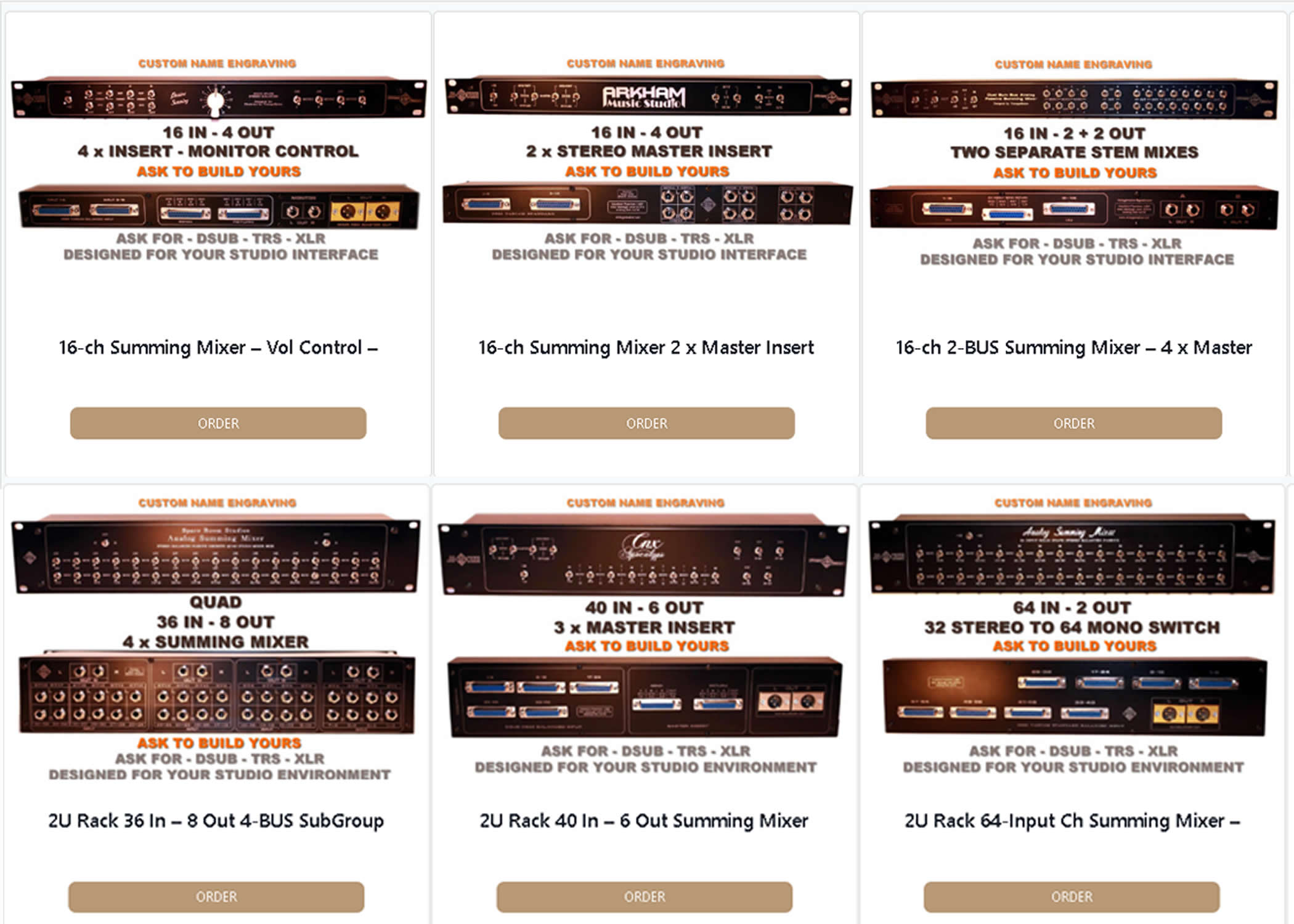
Check out our 1U–2U 19″ rackmount passive summing mixers!
Compatible with all major DAWs including Ableton Live, Logic Pro, Pro Tools, Cubase, FL Studio, Reaper, Studio One, Bitwig, Digital Performer, GarageBand and more.