
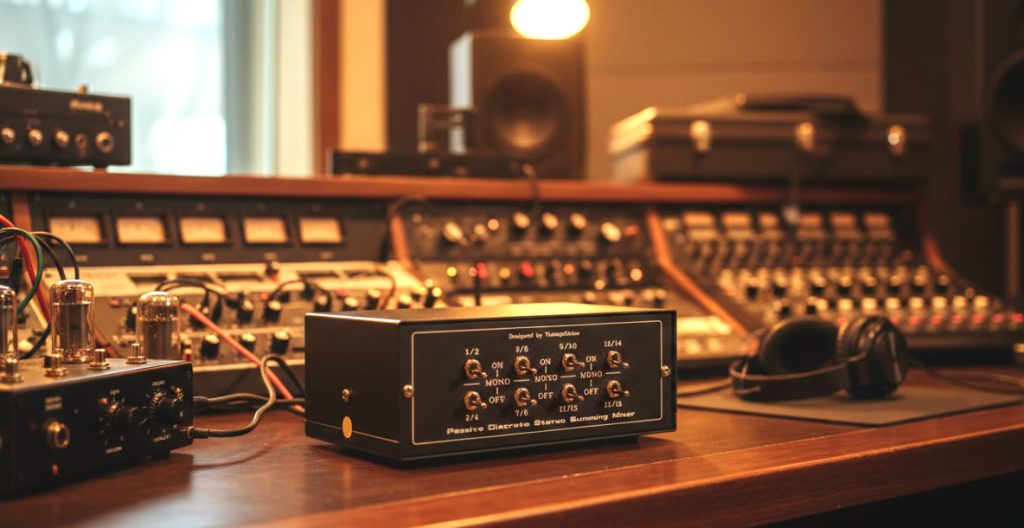
LittleOne Synth: Desktop Passive Summing Mixer for Hardware Instruments
Analog Summing for Drum Machines, Modular & Keyboards
A passive analog summing mixer built for hardware instrument workflows. Custom-calibrated to your synthesizers, drum machines, keyboards, Eurorack system, and DAW interface.
Price range: €160 – €430 (depending on configuration)
The LittleOne Synth, Drum & Modular Summing Mixer delivers real analog summing in a compact desktop format for hardware-focused studios and hybrid live rigs. Optimized for the signal levels, connector formats, and routing requirements of hardware synthesizers, drum machines, samplers, modular systems, and DAW stem outputs on the same analog bus.. ← Explore all desktop passive summing mixer configurations

Why Hardware Instruments Benefit from Dedicated Analog Summing
Hardware synthesizers, drum machines, and modular systems produce real analog voltages. Routing these signals into a DAW for digital summing requires AD/DA conversion — the signal is converted to digital, combined mathematically, then converted back to analog. A clean process, but one that eliminates the physical interaction between signals that defines analog character.
Routing hardware outputs through a dedicated passive summing network allows signals to interact in the analog domain before any AD/DA conversion occurs — resulting in tighter low-end definition, more natural instrument separation, and the harmonic coherence of a real analog mix bus.
The intention is not to replace digital mixing but to provide a dedicated analog summing stage optimized for hardware instrument workflows.

Compatible Hardware Instruments
| Instrument Category | Examples |
|---|---|
| Analog synthesizers | Moog Subsequent 37, Moog Minitaur, Moog Grandmother; Korg MS-20 Mini, Korg Minilogue XD; Roland SE-02, Roland SH-4d; Behringer Model D, Behringer Neutron; Dreadbox Typhon; Novation Bass Station II |
| Drum machines | Elektron Analog Rytm MKII, Elektron Syntakt; Roland TR-8S, Roland TR-6S; Korg Volca Drum, Korg Volca Sample; Sequential Tempest |
| Samplers | Akai MPC One, Akai MPC Live; Elektron Digitakt; Roland SP-404 MKII |
| Keyboards | Most hardware synthesizer keyboards with line-level or instrument-level outputs |
| Eurorack modular | Any Eurorack modular system with line-level or attenuated outputs via DI or output module |
| DAW software instruments | Virtual instruments (VST, VST3, AU, AAX) routed through audio interface outputs alongside hardware instruments |
What This Unit Does Differently
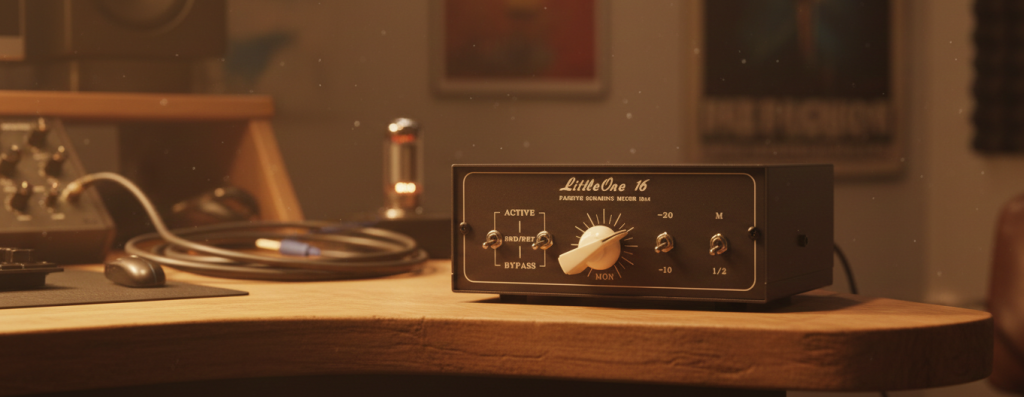
While the standard LittleOne desktop configurations are designed primarily for DAW stem routing at balanced +4 dBu line level, the LittleOne Synth is optimized for the electrical and workflow characteristics of synthesizer and drum machine outputs — while remaining fully compatible with DAW integration on the same analog bus.
Signal Level Calibration
Hardware instruments typically operate closer to -10 dBV instrument-level output rather than professional +4 dBu line level. Each unit is calibrated to match the actual output characteristics of your specific instruments rather than a generic studio reference standard.
Connector Format Matching
Common instrument output formats include ¼” TS, ¼” TRS, and 3.5 mm mini-jack connections. The LittleOne is built with the connector topology required by your setup, eliminating the need for adapter chains or external conversion boxes.

Flexible Channel Routing
Mono synthesizer outputs are typically routed to center summing paths for bass and lead instruments, while stereo sources such as drum machines can be configured as matched stereo pairs by the Mono conversion switch. Channel architecture can be customized at the hardware level.
Eurorack Integration
The system supports modular synthesizer environments using appropriate attenuation and impedance matching when interfacing with Eurorack output stages or dedicated module outputs.

| Input Channels | 4 – 24 (custom configurable) |
| Summing Topology | Floating Differential Bus – fully balanced, isolated ground – accept unbalanced signal too |
| Resistor Network | Vishay Dale precision, military-grade |
| Connectivity specify when ordering | 6.3 mm (¼”) TRS, TS, 3.5 mm mini-jack, XLR, or DB-25 (D-Sub) — specified per channel when ordering |
| Mono – Mute Switch | Yes – configured to your routing requirements |
| Variable Headroom Gain Switch | Selectable configurations: -6/-16 dB, -10/-20 dB, or -15/-25 dB |
| Sum-Bus Attenuation | Available in -6, -10, -15, -20, or -25 dB steps |
| Power | Fully passive – no external power required |
| Signal level calibration | -10 dBV (instrument) or +4 dBu (line) – matched to your hardware outputs |
| Build Time | 10–16 working days after configuration approval |
| Origin | Handcrafted in EU since 201 |
The Passive Advantage for Hardware Instruments
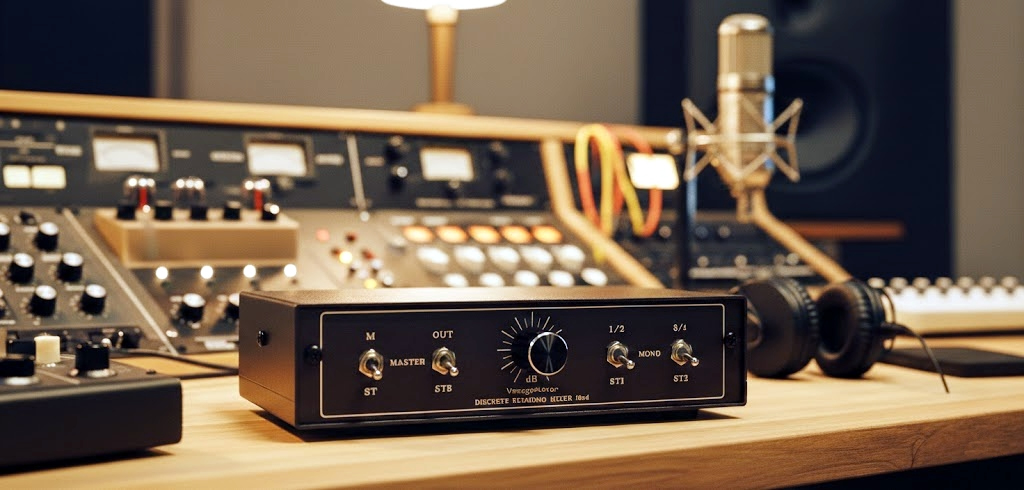
Passive analog summing introduces no active electronics into the signal path before the makeup gain stage. Your synthesizer’s oscillators, filter, and VCA are summed through a precision resistor network before any amplification occurs — preserving the raw character of the instrument’s analog circuitry without added noise floor or the tonal coloration that active mixing stages introduce.
The LittleOne Synth uses a Floating Differential Bus architecture, which electrically isolates the ground reference of each input channel. In multi-instrument hardware setups, synthesizers and drum machines from different manufacturers often carry slightly different chassis ground potentials. Without isolation, these differences create ground loops — audible as hum or interference in the summed output. The differential bus eliminates this by design, making it a practical solution for real-world hardware rigs.

Using DAW Software Instruments Alongside Hardware
The LittleOne Synth works equally well for producers who blend hardware instruments with software plugins. Route DAW software instrument outputs through your audio interface’s line outputs into the summing mixer alongside your hardware returns. Both signal paths meet physically in the analog bus — giving software instruments the same headroom behavior and signal interaction as the hardware sources.
For level matching, set your DAW output levels to correspond with the nominal output levels of your hardware instruments before they reach the summing bus. This ensures consistent gain structure across all inputs and allows the passive network to sum all sources with predictable attenuation across the full mix.
What Engineers and Producers Say
“I was skeptical about passive summing — read enough forum debates to know it’s a contested topic. What convinced me wasn’t theory, it was patching my Roland Tr-8s individual outputs through the LittleOne and comparing it to straight-to-interface routing. The kick and bass relationship felt more resolved, less like two separate elements competing for the same space. It’s not a dramatic transformation, but it’s consistent and repeatable, which is what matters in a production workflow.” – Tom Varga
“I’ve spent decades working with Moog, Sequential, and a range of classic analog gear — I know exactly what it sounds like when the raw character of hardware gets flattened in a digital mix. The LittleOne keeps that character intact. Gain structure is straightforward, the analog signal path does what it should, and nothing gets in the way of the instruments themselves.” – Daniel Morariu
“I run Elektron and Roland gear, and summing individual outputs in the analog domain before they hit the DAW makes a real difference. The low end is tighter, the mix has more cohesion, and the transients feel physical rather than processed. The Analog Rytm through the LittleOne sounds like a drum kit in a room – not a sample player.” – Alex Brendford
“I have Eurorack modular, a couple of desktop monosynths, and a Digitakt, all feeding into Ableton. Before the LittleOne I was summing everything inside the DAW, and the mix always felt like it was fighting itself in the low-mids. Running the modular voices through the passive bus first made an immediate difference in how the elements sit relative to each other. No ground hum issues either, which was my main concern mixing Eurorack with line-level passive gear from different manufacturers.” Marcus L.

Frequently Asked Questions
What is a synth summing mixer and why use one?
A synth summing mixer combines multiple synthesizer outputs into a single analog mix bus before conversion to digital. This allows your hardware instruments to interact electrically in the analog domain, preserving transient detail, stereo depth, and low-frequency clarity compared to purely digital summing
Is the LittleOne Synth right for my hardware setup?
If you run multiple synthesizers — Moog, Sequential, Korg, Roland, or similar — yes. The LittleOne works as a dedicated passive synth summing mixer with each channel calibrated to your actual instruments and audio interface. Signal levels, connector formats, and gain structure are matched to your specific rig, not a generic studio standard.
How does it work for drum machines and samplers?
Multi-output gear such as Elektron, Roland, or Akai devices are summed in the analog domain before DAW conversion. Individual outputs – kick, snare, hats, percussion – interact physically on the analog bus, improving low-end definition, transient coherence, and the kind of mix glue that digital summing cannot replicate.
Will it add noise to my sound?
No. The passive circuit introduces no active electronics and no internal power supply into the signal path, so it adds no noise of its own. Provided your input signals are clean, the summed output will be equally clean.
Will it color my sound?
In the best sense, yes. Passive analog summing introduces the natural warmth and harmonic cohesion of a real analog mix bus — the kind of character that comes from signals interacting physically in the analog domain rather than being combined mathematically. Beyond that, the signal path remains transparent and clean, with no imposed tonal character, noise, or dynamic processing. Final color is shaped by your external preamp or interface gain stage.
Can it function as a keyboard mixer for multiple keyboards?
Yes. It works as a keyboard mixer for combining multiple hardware keyboards and synthesizers. Stereo and mono keyboards can be connected simultaneously, maintaining proper balance and stereo imaging.
Can I mix DAW instruments with hardware synth?
Yes. Route your DAW software instrument outputs — VST, VSTi, VST3, AU, AAX, or RTAS — from your audio interface’s analog line outputs into the LittleOne, alongside your hardware instruments. This allows your software and hardware sources to combine in the same analog summing stage, giving your virtual instruments the same analog environment and resulting in a more cohesive, unified mix.
Do I need makeup gain?
Passive summing attenuates the combined signal typically between -6 dB and -20 dB. Your audio interface MicPre and line inputs or external preamps provide the necessary makeup gain. Each LittleOne is calibrated so the attenuated output lands in the optimal input range for your specific interface, so no additional outboard equipment is required in most setups.
Can the LittleOne be used with Eurorack modular systems?
Yes. Eurorack and modular synthesizer signals are supported through proper attenuation and impedance matching, configured during the custom build process.
Can I expand my synth summing box later?
Expansion is possible, but ordering the full required channel count initially is recommended. Unused input channels do not affect audio quality, headroom, or signal integrity.
Is a rackmount version available?
Yes. The LittleOne Synth summing mixer is available in both desktop and rackmount configurations. Format preference can be specified during the custom build order.
Technical Summary & Performance Specs
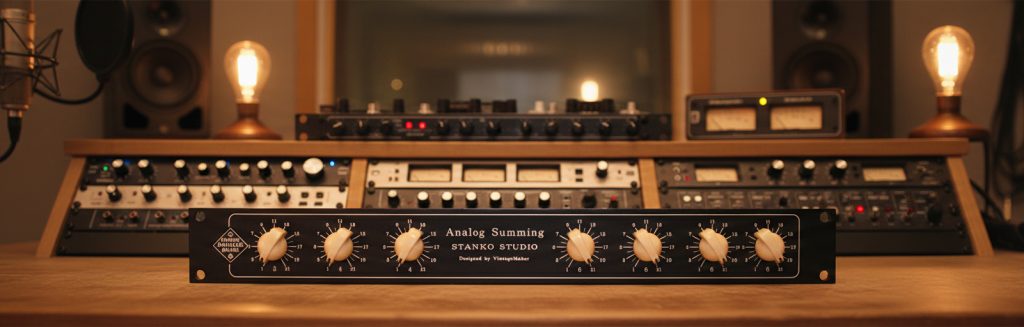
The LittleOne Synth uses the same Floating Differential Bus architecture as larger VintageMaker systems, delivering professional analog bus interaction in a compact passive format optimized for hardware instrument workflows.
Interface-Specific Calibration — Precision-engineered to match the I/O voltage and impedance of your specific audio interface — RME, Apollo, Focusrite, MOTU, or similar — ensuring optimal gain staging and a low noise floor across the full signal chain.
Phase-Coherent Summing — Isolated-ground topology eliminates ground loops between instruments from different manufacturers and preserves absolute phase integrity, resulting in a stable center image and consistent stereo width across the full mix bus.
Precision Signal Path — Built with Vishay Dale precision resistors at 0.1% matching accuracy for maximum transparency, transient detail, and predictable attenuation across all input channels.
Custom Channel Architecture — Available in 4 to 24 channel configurations with mono and stereo input options, connector format selection, and signal level calibration matched to your specific instrument outputs and routing requirements.
Fully Passive — No power supply, no active electronics, no electronic noise floor. Pure signal path from instrument output to makeup gain stage.
Order & Configuration
