LittleOne Wide – 8–16 Channel Desktop Passive Summing Mixer
Mid-size analog summing for hybrid studios with 8 to 16 outputs. Custom-calibrated to your interface, hand-built to order. Real headroom, wide stereo imaging, and natural harmonic character – from 8 to 16 channels.
Price range: €180 – €350 (depending on configuration)
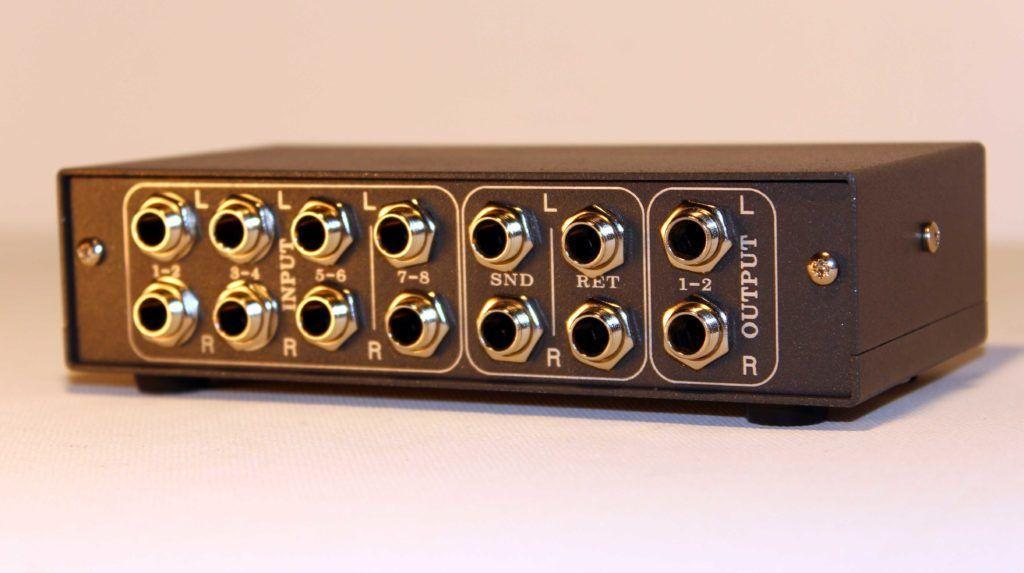
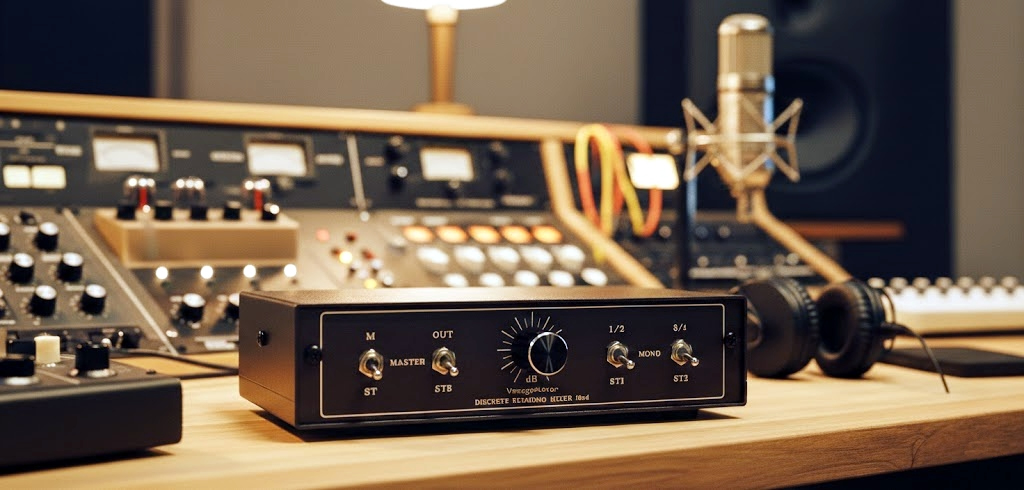
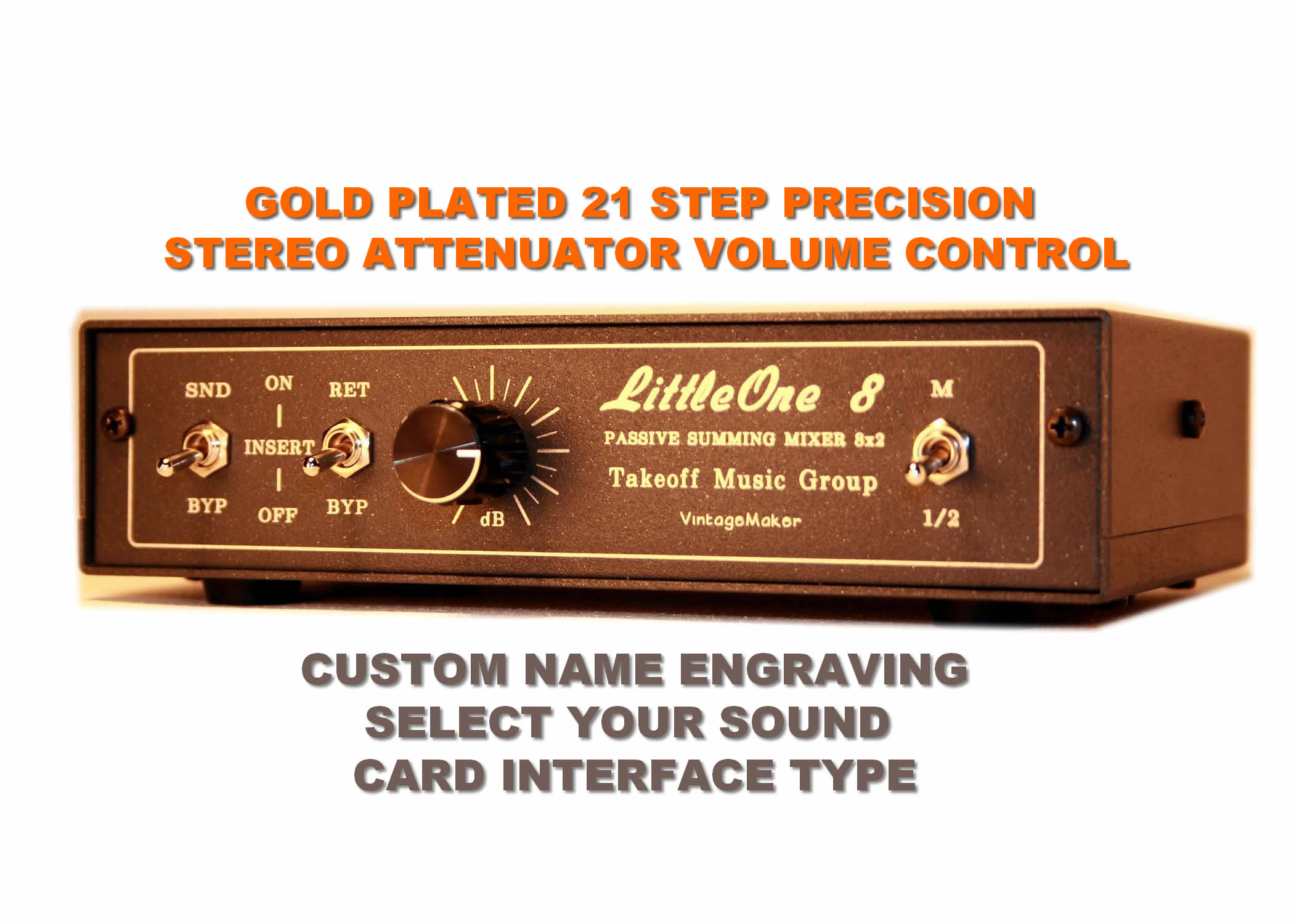
The LittleOne Wide is a handcrafted desktop passive summing mixer for mid-sized hybrid setups, built and calibrated specifically to your audio interface. It delivers the physical signal interaction of real analog summing across 8 to 16 channels – wider stereo depth, improved instrument separation, and natural harmonic character – without active circuitry, power supplies, or complex signal routing.
Available in 8, 10, 12, 14, or 16 Channel Configurations
← Explore all desktop passive summing mixer configurations
Why the 8–16 Channel Range
The 8–16 channel configuration is the most practical and flexible choice in the LittleOne Wide desktop lineup. It fits the needs of most professional hybrid workflows while staying compact enough to place on a desk next to your audio interface and studio monitors. This channel range is ideal for separating common mixing elements into dedicated stereo pairs — mono sources such as drums, bass, and lead instruments alongside stereo groups like synths, vocals, effects, and parallel processing chains.

As more channels are added to an analog summing bus, the interaction inside the bus also increases. When eight channels are actively feeding the SUM bus, you begin to hear more harmonic blending, stronger cohesion, and a wider stereo image compared to four channels. With sixteen channels, the mix gains even more depth and dimensional richness. The 8–16 channel range is where the physical characteristics of analog summing start to show their full musical benefit.
Custom Calibration – The Core Advantage
Every LittleOne Wide is calculated and built around your specific audio interface’s output voltage and mic preamp gain structure. This is not a post-production
adjustment – it is fundamental to how the resistor network is designed for each unit. The result:
⦁ Correct impedance interaction between summing bus and makeup gain stage
⦁ Maximum signal-to-noise ratio for your specific interface
⦁ Predictable gain staging – no surprises between DAW level and summed output
⦁ Optimal headroom behavior for your studio’s working levels
⦁ Phase-coherent summing across all 8–16 channels
8–16 Channel Configuration Overview
| Input Channels | 8, 10, 12, 14, or 16 (custom configuration) |
| Summing Topology | Floating Differential Bus – fully balanced, isolated ground. Unbalanced sources accepted |
| Resistor Network | Vishay Dale precision, military-grade |
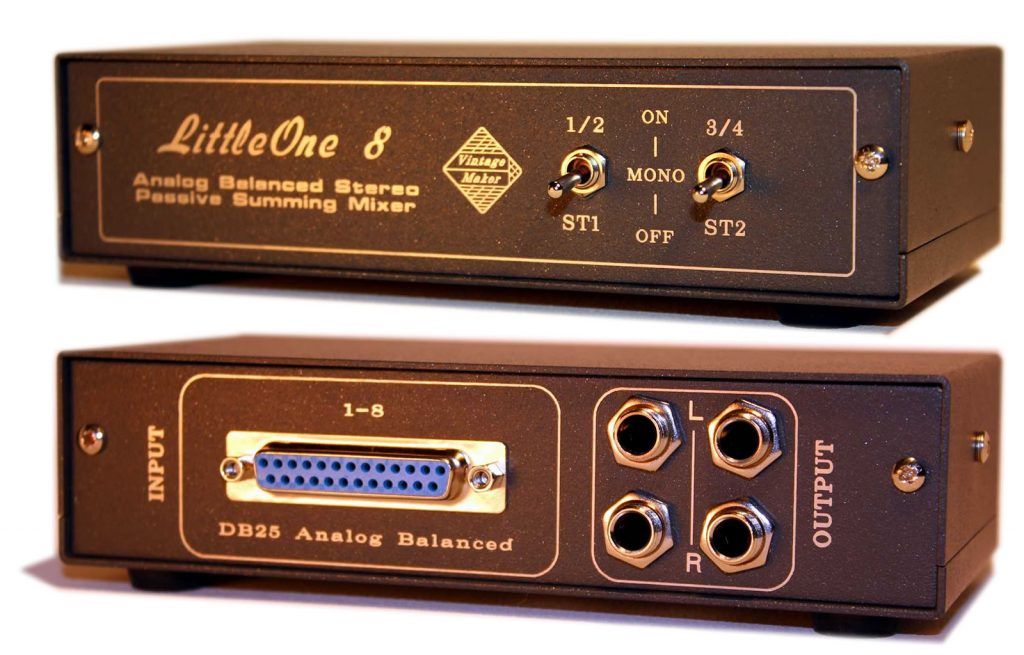
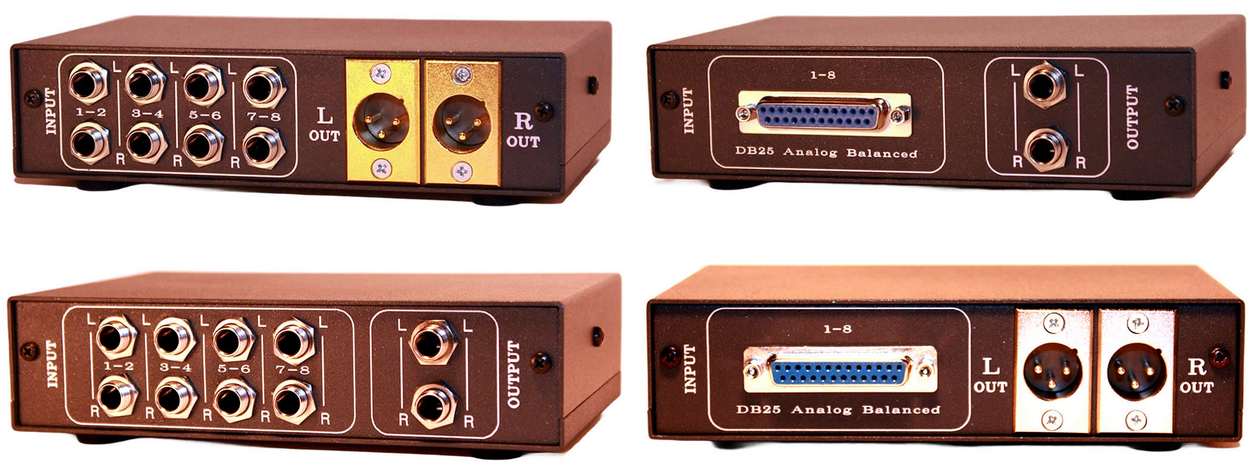
| Connectivity -specify when ordering | Balanced TRS or XLR or DB-25 (D-Sub) |
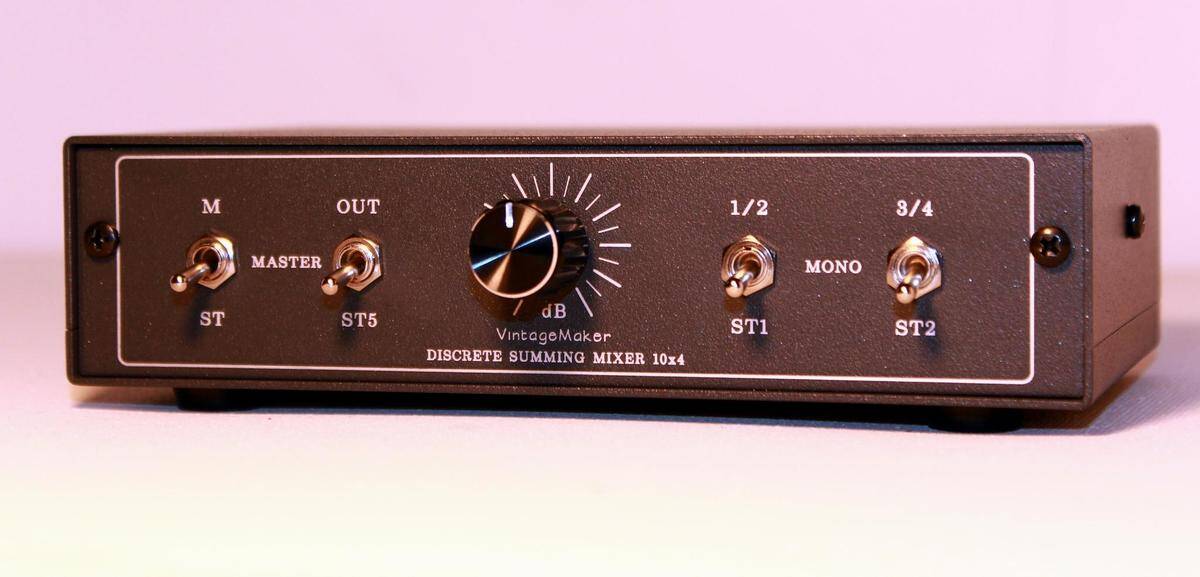
| Mono / Mute Function | Optional per-channel mono/stereo input switching |
| Variable Headroom Gain Switch | Selectable configurations: -6/-16 dB, -10/-20 dB, or -15/-25 dB |
| Summing Bus Attenuation | Available in -6, -10, -15, -20, or -25 dB steps |
| Power | Fully passive – no external power required |
| Format | Desktop – 160 × 38 × 100 mm (6.3 × 1.5 × 3.9 in) |
| Build Time | 10–16 working days after configuration approval |
| Origin | Handcrafted in EU since 2010 |

Gain Staging with the LittleOne Wide
The precision resistor network combines signals while creating a protected headroom zone. Understanding the gain structure helps you get the most from the unit:
Minimal SUM BUS Reduction: -6.5 dB (up to -25 dB)
This mandatory attenuation creates the analog headroom needed for clean transients and dynamic peaks. Without it, there is no proper analog summing. Each unit is custom-calibrated to your DAW interface. This is physics, not a design limitation — so please don’t ask for 0 dB summing.
Variable Headroom PAD Switch (Optional)
For hot signals from DAW outputs. Available configurations: -6/-16 dB, -10/-20 dB, or -15/-25 dB. Engaging the PAD when sending high-level signals prevents overdriving the downstream preamp while still allowing controlled harmonic behavior at the summing inputs.
Cumulative Bus Level with 8+ Channels
When sending 8 or more channels at levels near 0 dBFS, the combined signal volume on the master stereo output increases — typically +2 to +3 dB above the base reduction. This is normal behavior in any passive summing network. The analog headroom handles it naturally, turning those peaks into subtle harmonic saturation rather than hard clipping.
Pro Tip: To achieve controlled analog harmonic distortion, gradually increase your DAW master fader or output levels. Driving the LittleOne Wide’s inputs slightly above nominal adds harmonic weight and 3D depth to the stereo bus without obvious saturation.
Ideal Workflows for the 8–16 Channel Configuration
- Full Stem Mixing Sessions: Drums, bass, instruments, synths, vocals, and FX as separate stereo pairs.
- Mid-Sized Home and Project Studios: Ideal for setups with 8–16 interface outputs.
- Layered Synth, Keyboard, and Electronic Production: Adds cohesion across multiple hardware and software layers.
- Parallel Processing Routing: Allows separate parallel compression or saturation chains as individual channels.
- Hybrid Setups: Combine DAW outputs with hardware instrument returns.
- Pre-Mastering Stem Summing: Provides additional analog depth before the mastering chain.
Compatible Interfaces
The LittleOne Wide works with any audio interface that has true balanced stereo outputs. Each unit is calibrated for your specific interface. Common compatible models include:
⦁ Focusrite Scarlett 18i20, Clarett+ 8Pre, Red 8Line
⦁ MOTU 828es, 8A, 16A, Ultralite AVB
⦁ Universal Audio Apollo x8, x8p, x16
⦁ RME Fireface UCX II, Fireface 802, UFX III
⦁ PreSonus Studio 1824c, Quantum 2626
⦁ Antelope Orion 32, Discrete 8, Discrete 4 Synergy
⦁ Steinberg AXR4, UR824 – Behringer ADA8200, UMC1820 – Apogee, Symphony, Ensemble
Custom calibration is available for any interface with balanced outputs and access to mic preamp or line inputs for makeup gain.
Customer Reviews & Real-World Use – What Engineers Say
Really transparent compared to high-end summing mixers
“I did some research and considered the Neve 5059 Satellite 16×2 + 2, but it’s extremely expensive. I also tested the Dangerous Music D-Box, which is active, and to my surprise I didn’t hear any added colour at all. It was transparent and clean with great Headroom – delivering approximately the same results as your passive LittleOne 8. Thanks Paul!” – Alexey Kononenko
this box does the trick
“I have 24 outputs from my MOTU interface. Sixteen go into my SSL X-Desk (8 Line-In + 8 Alt-In channels with SuperAnalogue summing). Since I had 8 additional outputs available, I wanted to sum them separately and route the result into one of the stereo return channels. The LittleOne 8-channel summing box fits perfectly into this setup.” – Paul Timber
gentle saturation trough mixer
“Managed to achieve that ‘gentle analog distortion’ as you said — the key factor is gain staging. Simply increase your DAW output level and push the summing mixer inputs above nominal level. It’s very easy and gives a very nice musical distortion. Thanks!” – David Tickler
When the LittleOne Wide Is Not the Right Tool
Single stereo sessions receive no benefit from passive summing. Analog bus interaction requires multiple channels – from 4 upward. With only one stereo
source, harmonic interaction, stereo widening, and bus cohesion simply do not occur. For single-stereo enrichment process, a Neumann or Filtek/SSL-style transformer
color amplifier is the more appropriate solution.
FAQ – LittleOne Wide 8–16 Channel Desktop Passive Summing Mixer
Do I need makeup gain or external preamps?
Your interface’s built-in mic preamps are sufficient. The LittleOne Wide is calibrated to your interface’s output level and preamp gain range — the passive network’s attenuation is matched to what your preamps can recover cleanly. No additional outboard equipment is required unless you want to add specific tonal character from a transformer-based or tube preamp design.
Can I order a 10 or 12 channel configuration?
Yes. The LittleOne Wide is available in 8, 10, 12, 14, or 16 channel configurations. Specify your exact channel count when ordering.
What is the difference between the LittleOne Mini and the LittleOne Wide?
The LittleOne Mini is designed for compact setups, supporting 4–8 channels for smaller interfaces. The LittleOne Wide expands this capacity to 8–16 channels, making it ideal for mid-sized hybrid studios with higher interface output counts and complex stem arrangements. Both units utilize the identical Floating Differential Bus architecture and custom calibration; the primary difference lies in the channel capacity and the resulting scale of bus interaction.
What cables do I need to connect the LittleOne Wide?
The LittleOne Wide accepts TRS 1/4″, XLR, or D-Sub DB-25 connections depending on the connector configuration chosen at order. Both balanced and unbalanced sources are accepted — balanced operation is recommended for optimal noise rejection.
How does the Mono switch work, and when should I use it?
The Mono Channel Conversion Switch converts a stereo input pair to two independent mono signals. It is best used for center-placed mono tracks such as kick drum, bass, and lead vocals. Engaging the switch ensures absolute center placement and maximum phase coherence for mono sources — identical to how large analog mixing consoles handle mono signals.
Can I use outboard compressors or EQs with the LittleOne Wide?
Absolutely. The LittleOne Wide integrates seamlessly with outboard compressors, EQs, and preamps. Because the passive resistor network is transparent, it does not interfere with the impedance or character of upstream or downstream equipment. Furthermore, the balanced architecture maintains signal integrity across your entire hardware chain.
Does the Headroom Gain PAD switch affect sound quality?
No. The PAD attenuation is completely transparent. It’s a flexible gain tool that helps you adapt the mixer to different workflows. Its main job is to give extra headroom, letting you drive your DAW outputs or preamps harder without clipping. This way, you can hit the “sweet spot” for your analog gear’s harmonic character.
Is the LittleOne Wide suitable for mastering workflows?
Yes. Many engineers utilize the LittleOne Wide as a pre-mastering stem-summing stage. By routing stems through the analog summing bus before the stereo mastering chain, you introduce bus-level cohesion, harmonic depth, and a natural headroom behavior that is difficult to achieve entirely “in the box” (ITB).
Can I use it for both small home studios and larger hybrid setups?
Definitely. The 8–16 channel summing mixer configuration is ideal for mid-sized DAW setups, stem mixing, layered synths, and compact hybrid workflows. For larger setups, consider the 16–24 channel desktop version or 1U–2U rackmount systems
What is the build and shipping time?
10–16 working days after configuration is confirmed. Each unit is built and calibrated to order. Rush build options are available on request.
Technical Summary & Performance Specs
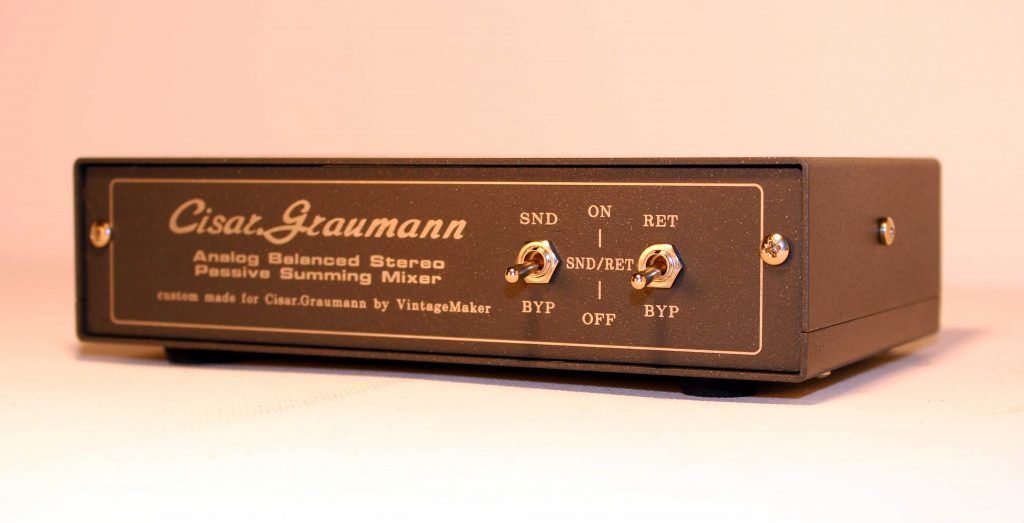
The LittleOne Wide is engineered for uncompromised signal integrity. The Floating Differential Bus architecture ensures a ground-independent summing environment, preserving the phase relationship of your stems across all channels.
- Custom Impedance Matching: Every unit is resistor-calculated to match your specific interface I/O’s for optimal gain staging and lowest noise floor.
- Precision Components: Built with precision-selected Vishay Dale resistors at 0.1% matching accuracy across the stereo field.
- Flexible Scalability: Available in 8, 10, 12, 14, or 16 channel configurations with consistent performance across all inputs.
- Passive Signal Path: No active components — final sonic character is determined by your chosen makeup gain stage.

Order & Configuration