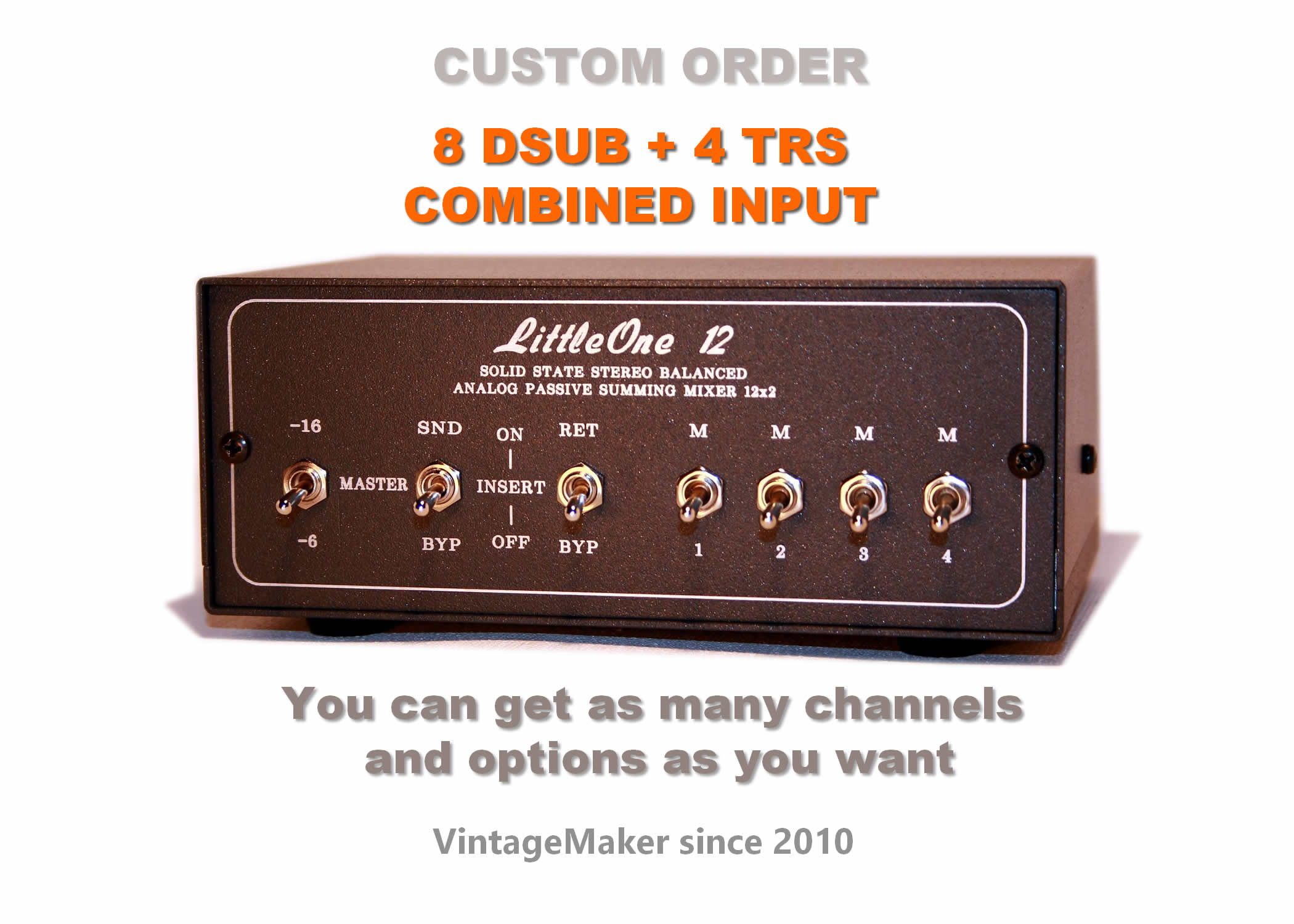
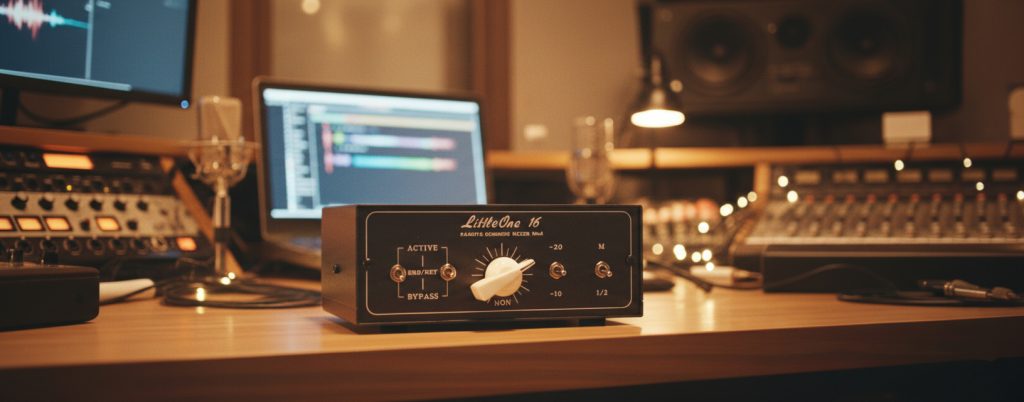
LittleOne 16–24 Channel Desktop Passive Summing Mixer
Maximum channel capacity in a desktop format. Custom-calibrated for your interface and designed for large hybrid sessions. True analog depth, stable stereo imaging, and phase-coherent summing at scale.
Price range: €220 – €350 (depending on configuration)
The LittleOne 16-24 is a custom-built passive analog summing mixer for producers and engineers working with 16, 18, 20, 22, or 24 outputs. It delivers maximum signal-to-noise ratio, proper impedance interaction, and the bus interaction responsible for the width, openness, and dimensional complexity of large analog mixes.
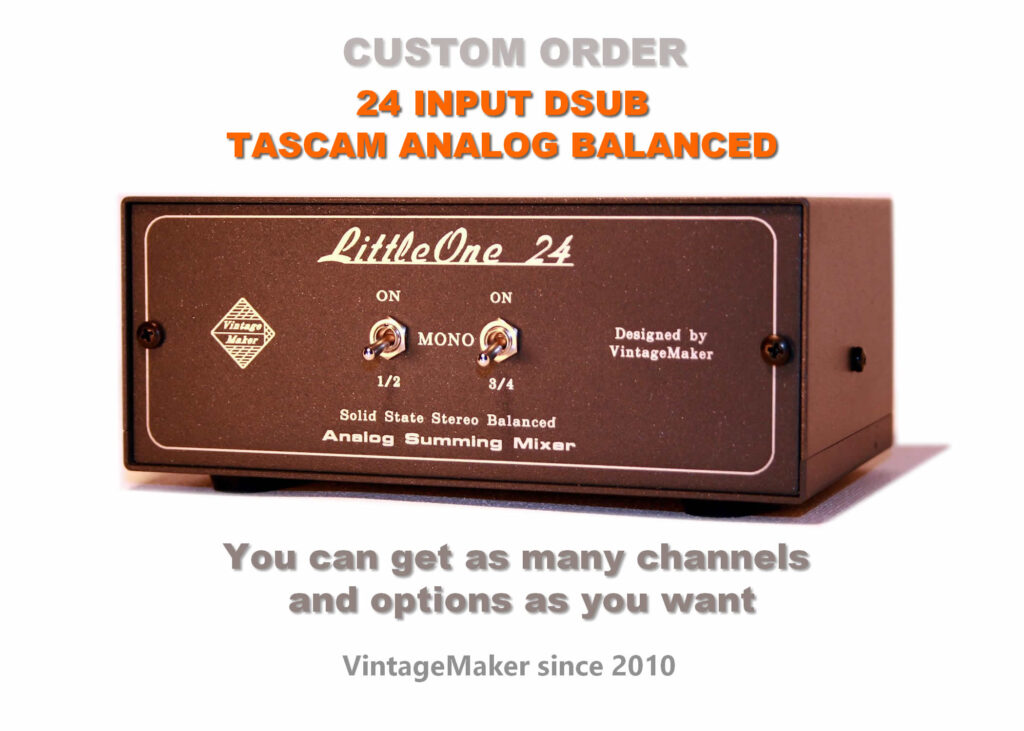
Available in 16, 18, 20, 22, or 24 Channel Configurations
← Explore all desktop passive summing mixer configurations
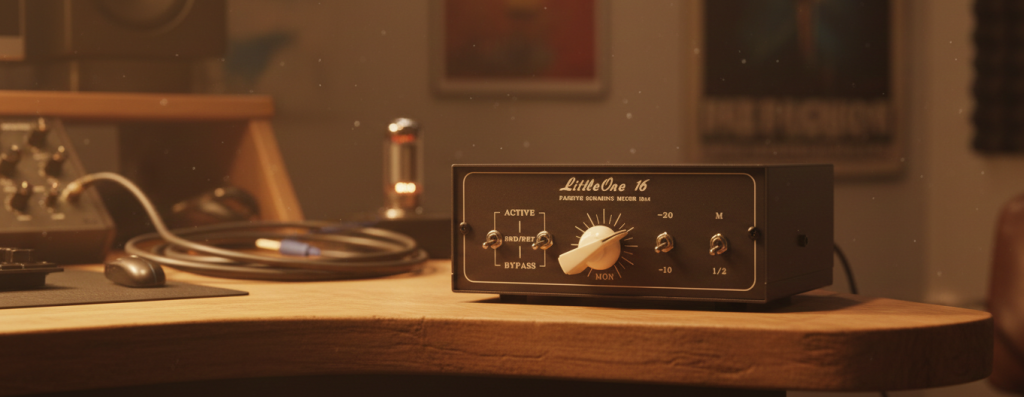
Why Move 16–24 Channels into the Analog Domain
Digital summing is mathematically precise, but dense sessions — stacked synths, parallel drums, multiple reverb returns, grouped instruments — can produce a congested, narrow stereo image that plugins alone struggle to fix.
Routing 16–24 outputs into a passive analog summing changes how signals interact. Multiple channels driving the analog bus simultaneously create natural voltage interaction, subtle harmonic enrichment, and stronger bus cohesion — preserving openness, depth, and stereo width as track count grows.
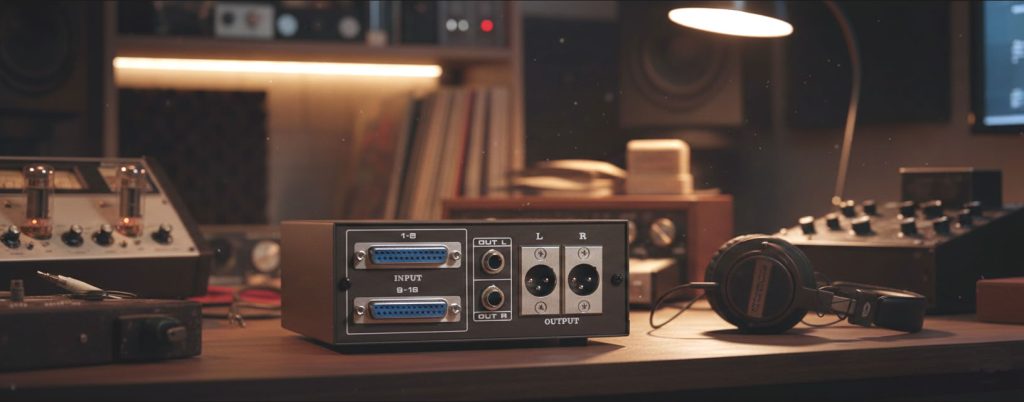
Configuration Options
| Channels | Application |
|---|---|
| 16 | Structured stem mixing — drums, bass, instrument groups, vocals, and FX |
| 18 | 16-channel stem structure with dedicated mono kick and bass channels |
| 20 | Large hybrid sessions with DAW and hardware synthesizer integration |
| 22 | High-density electronic or orchestral routing with extensive outboard |
| 24 | Maximum configuration — full-scale stem summing with hardware-centric workflow |
Technical Overview
| Specification | Detail |
|---|---|
| Input Channels | 16, 18, 20, 22 or 24 (custom configuration) |
| Summing Topology | Floating Differential Bus – fully balanced, isolated ground. Unbalanced sources accepted |
| Resistor Network | Vishay Dale precision, military-grade |
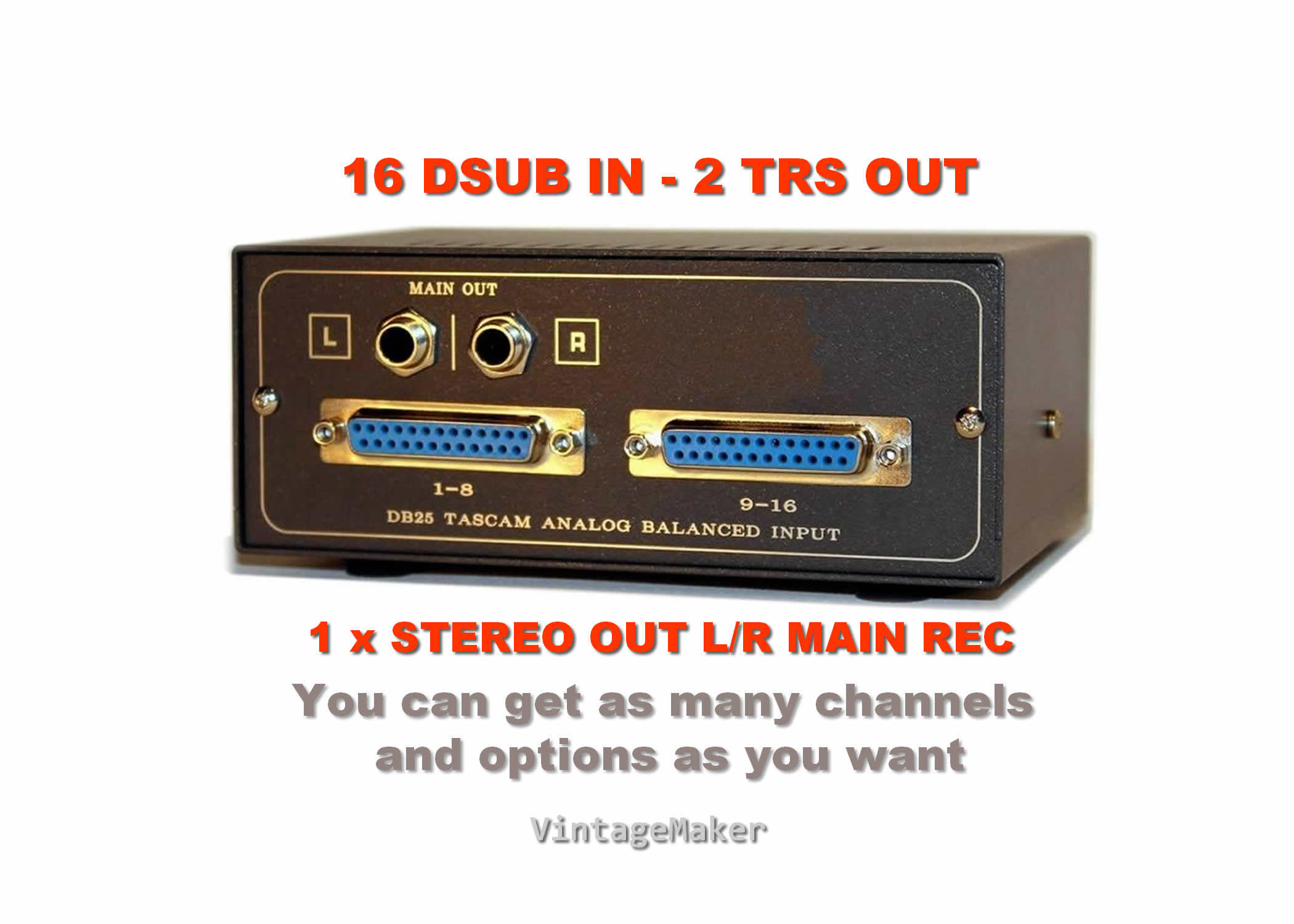
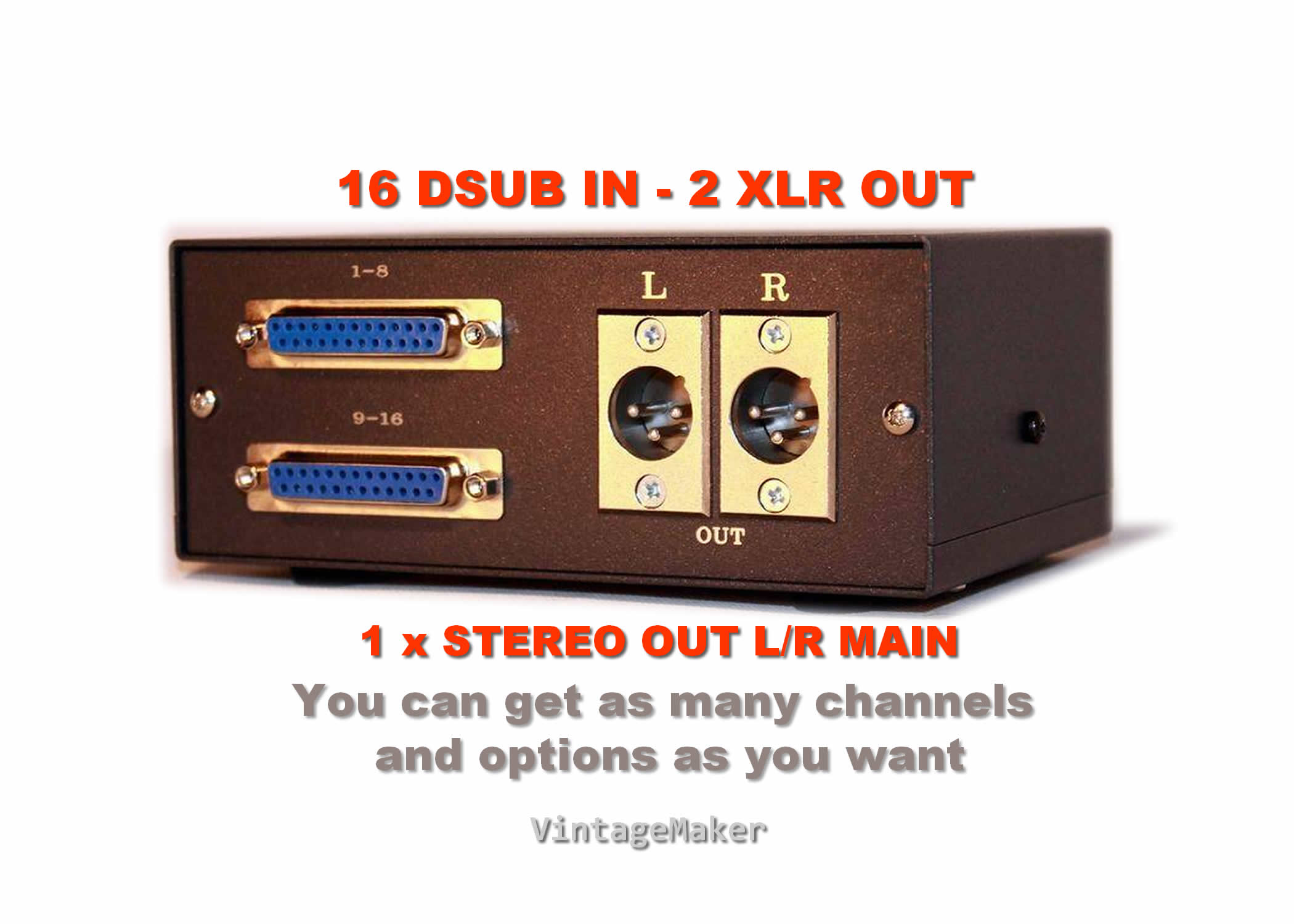
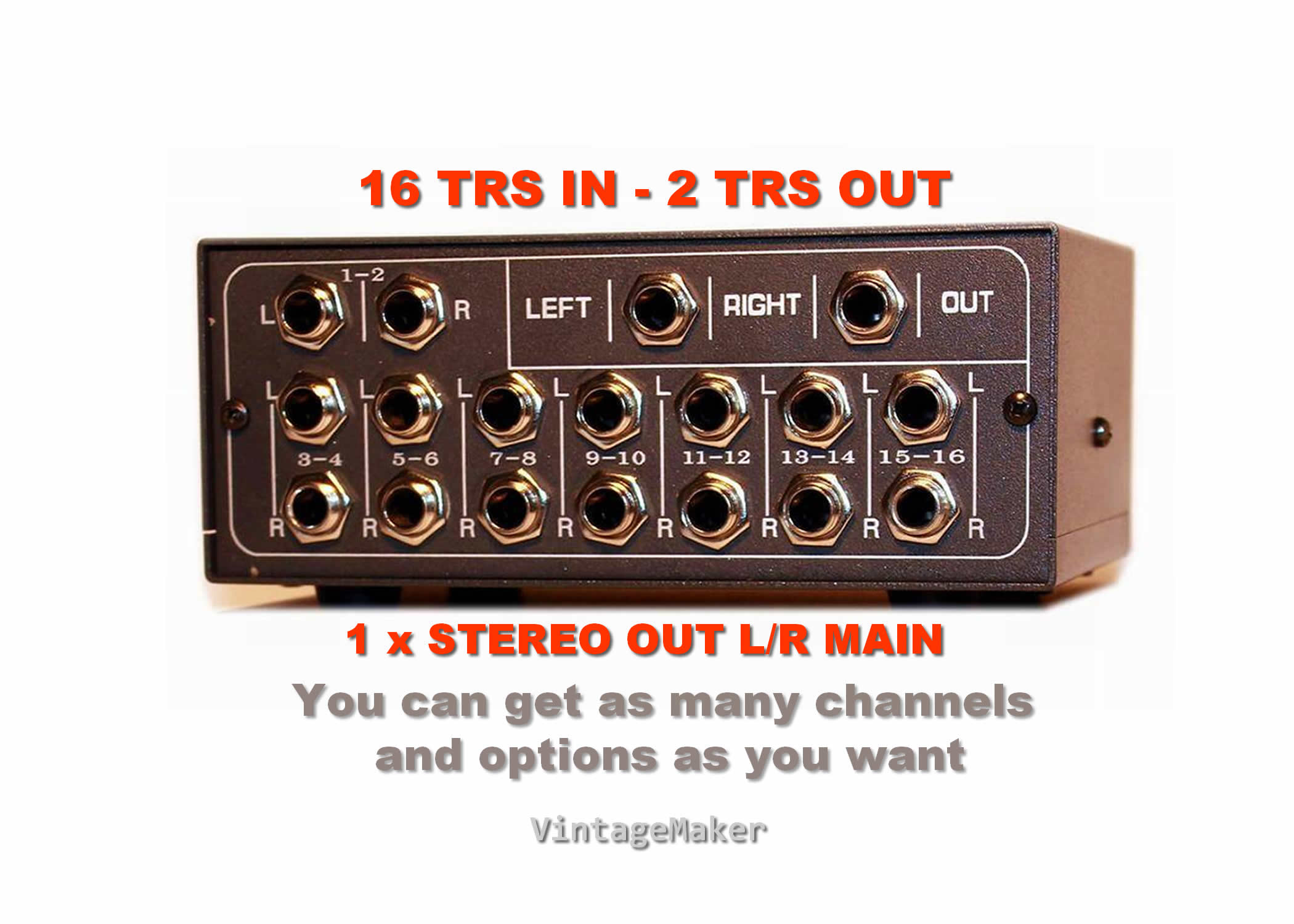
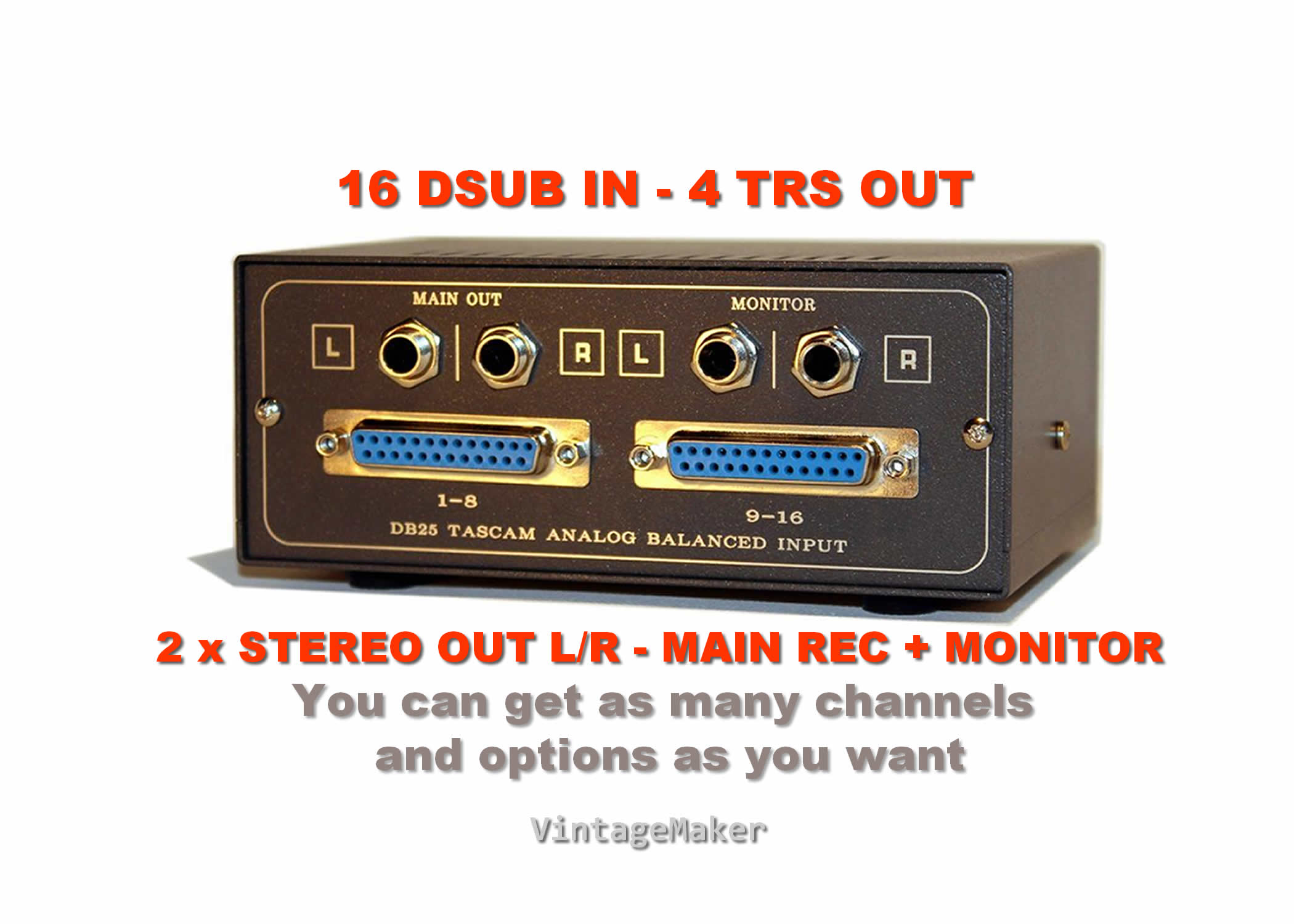
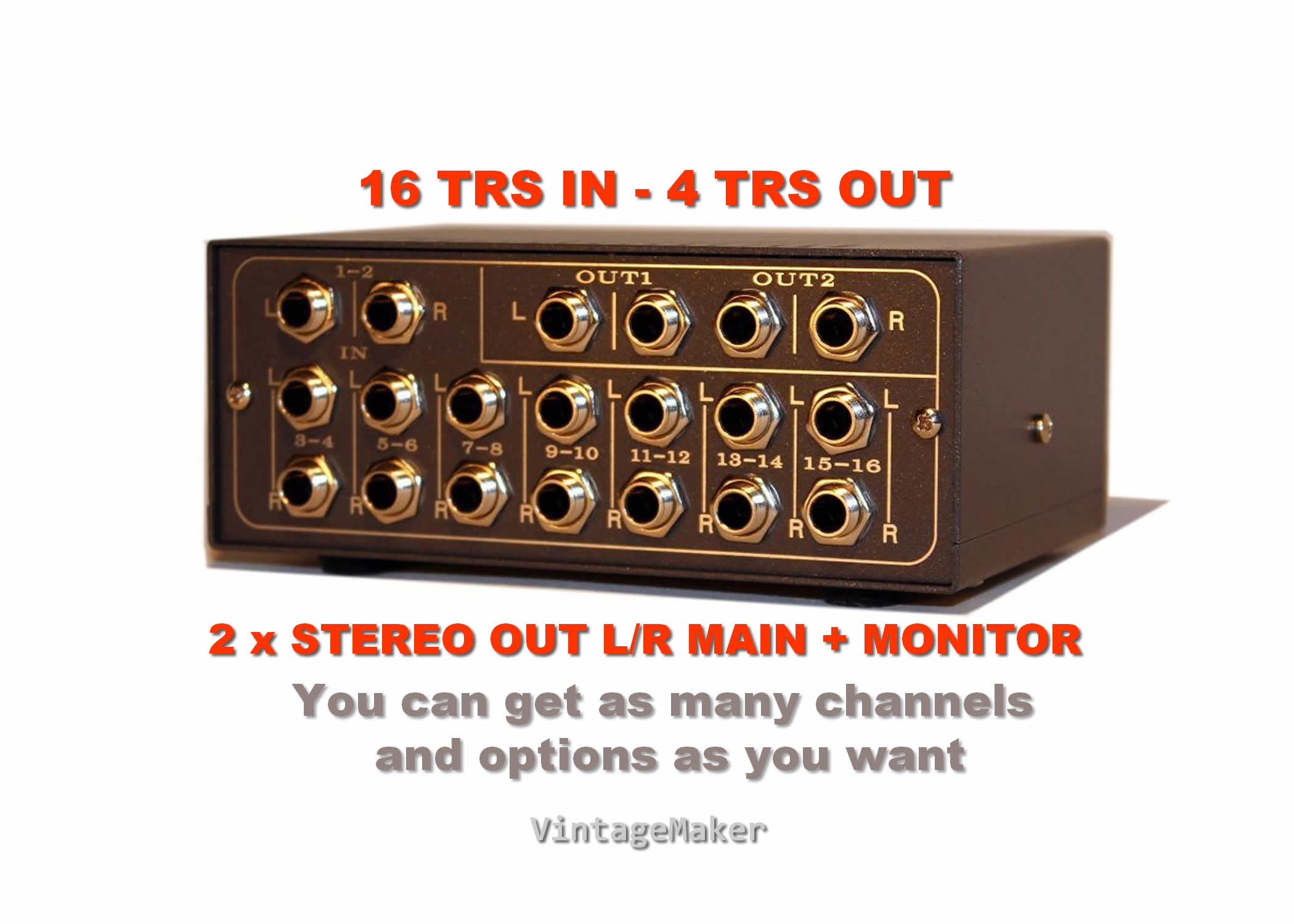
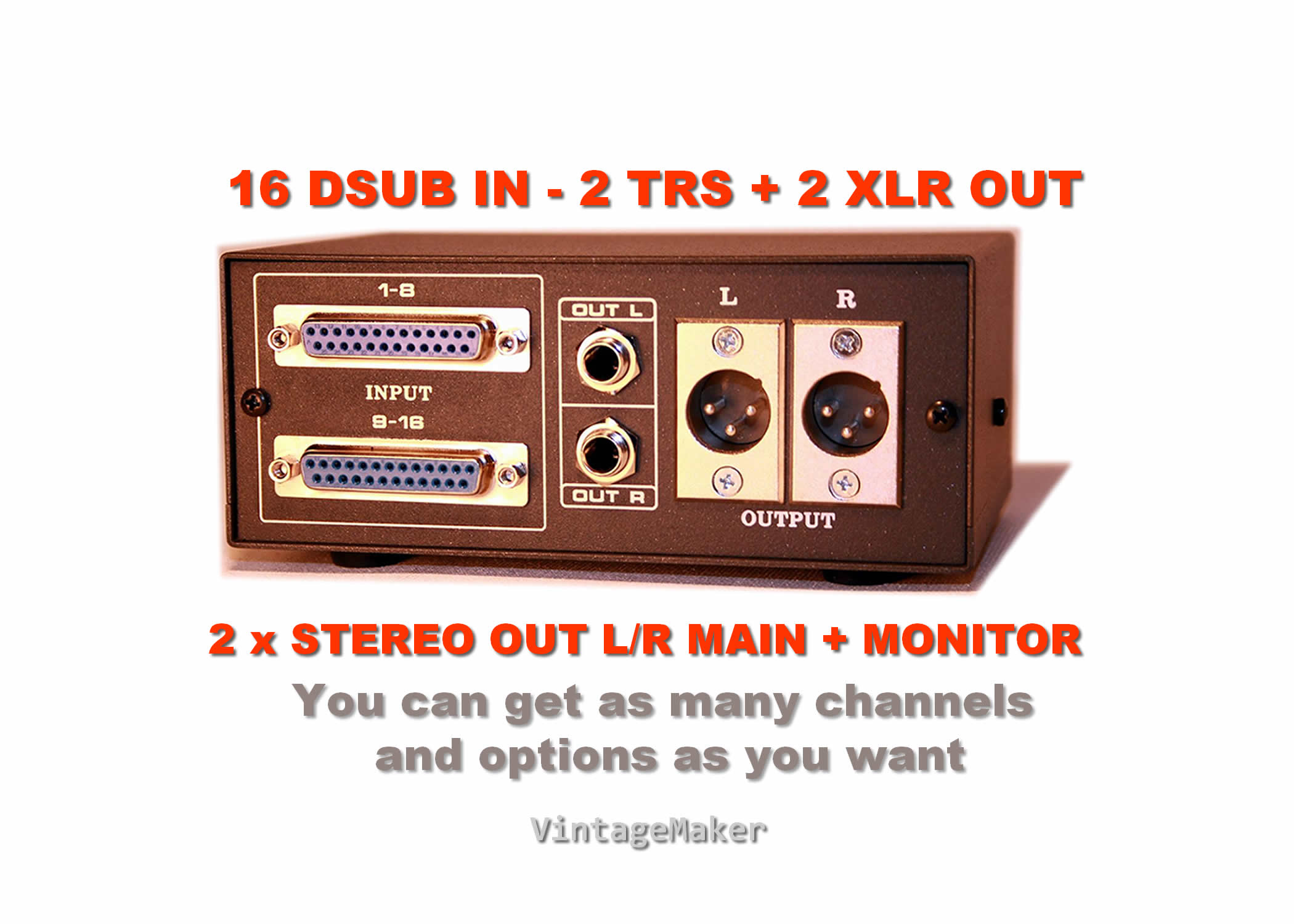
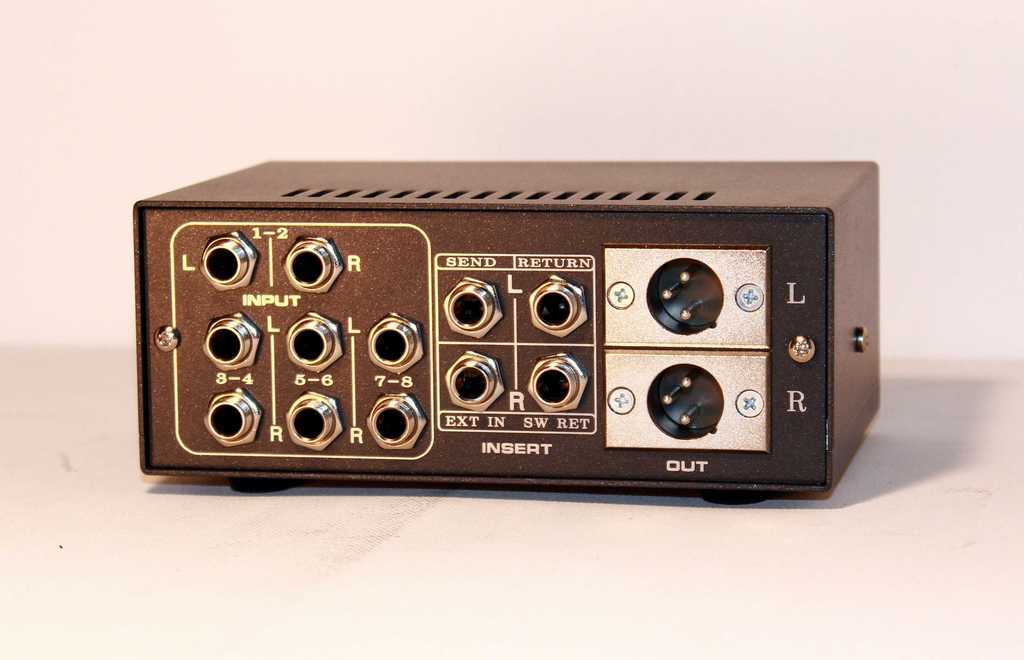
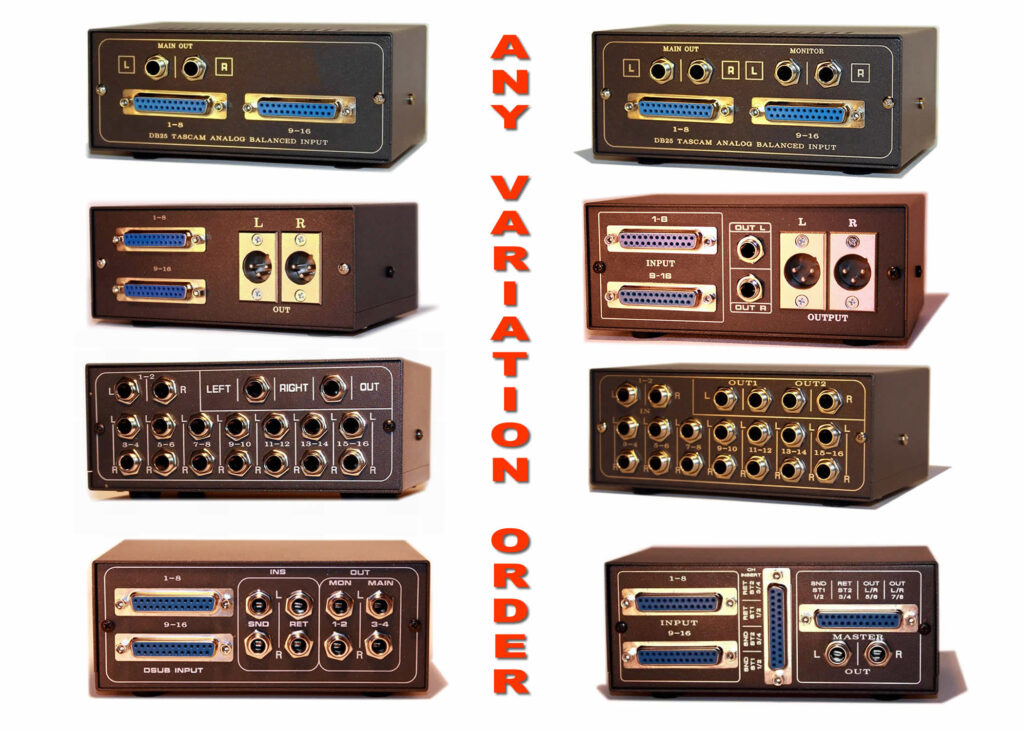
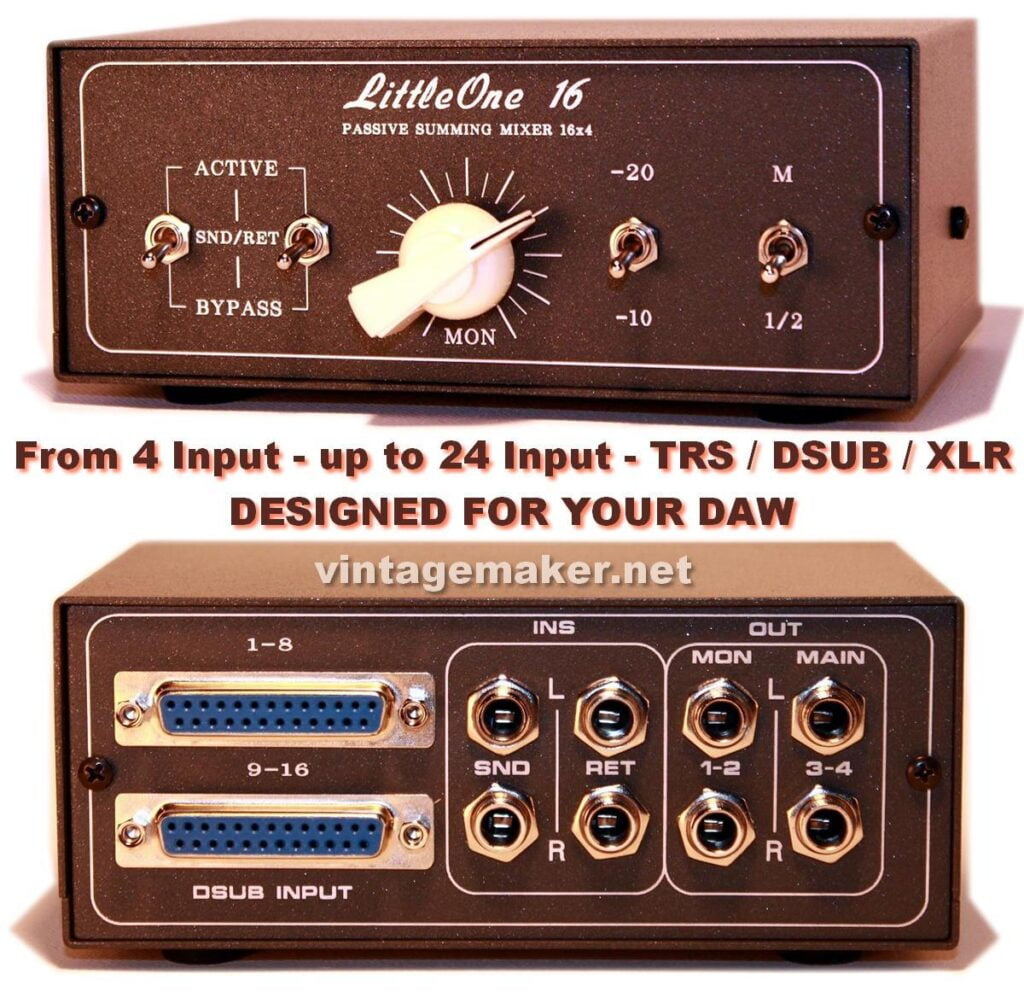
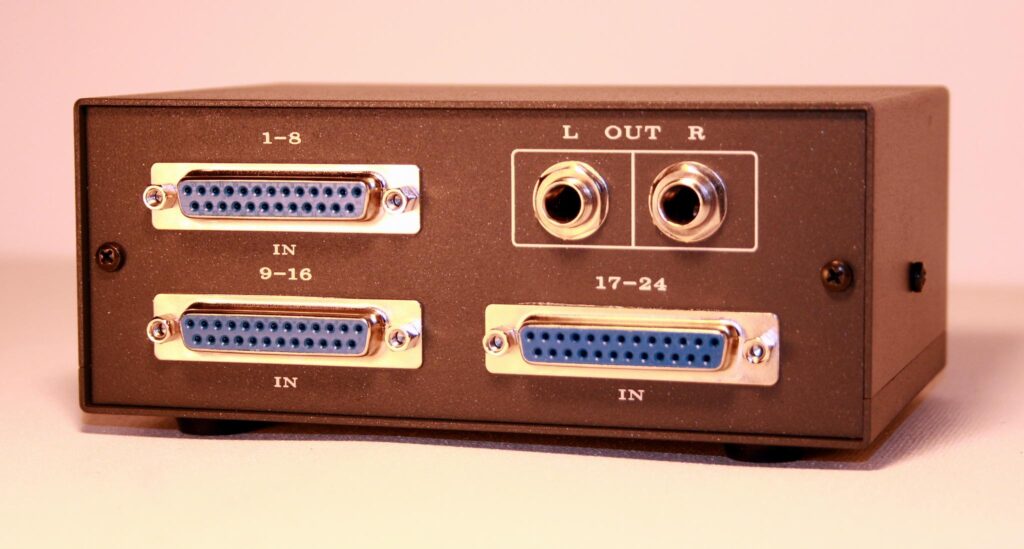
| Connectivity (specify when ordering) | Balanced TRS or XLR or DB-25 (D-Sub) |
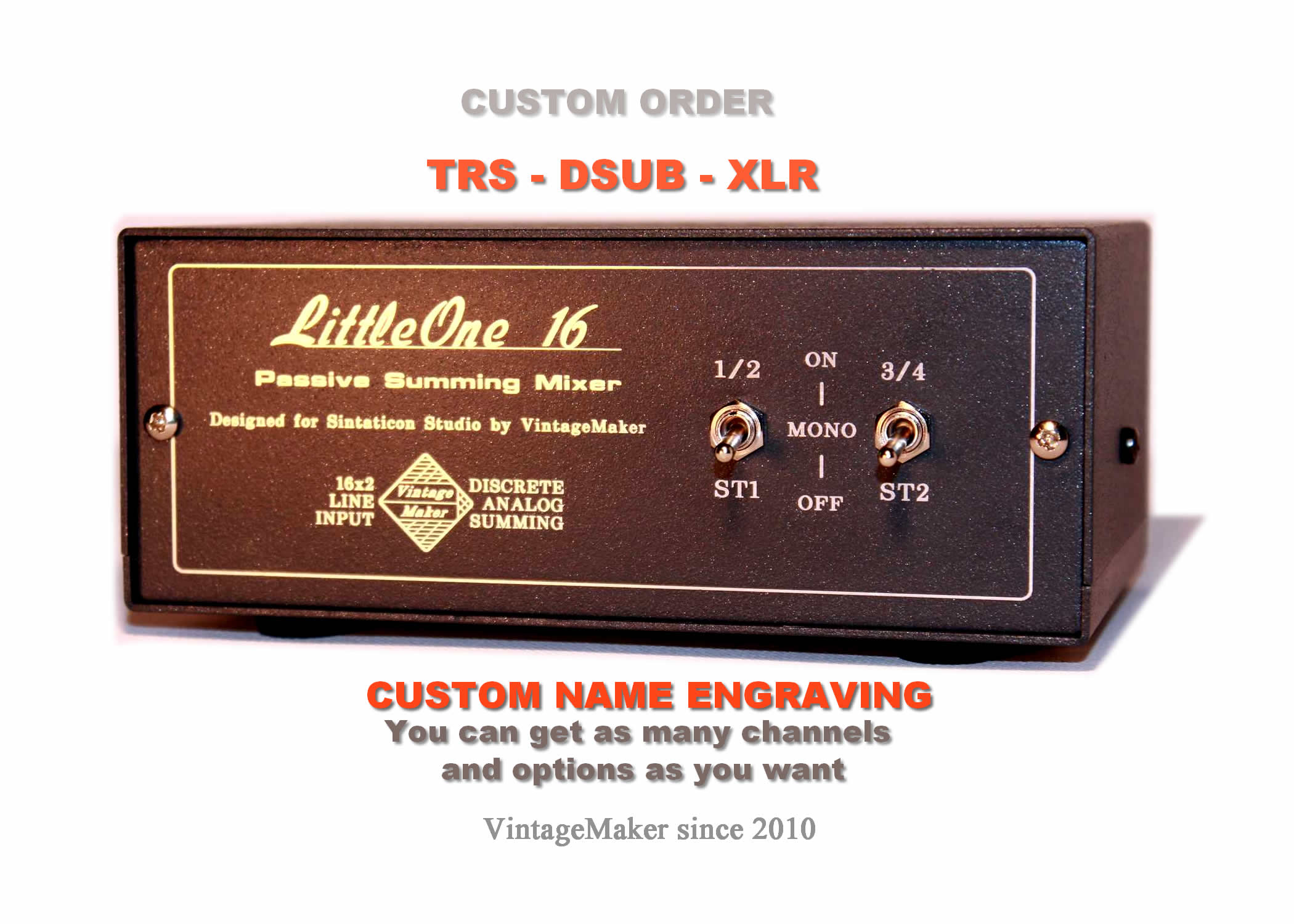
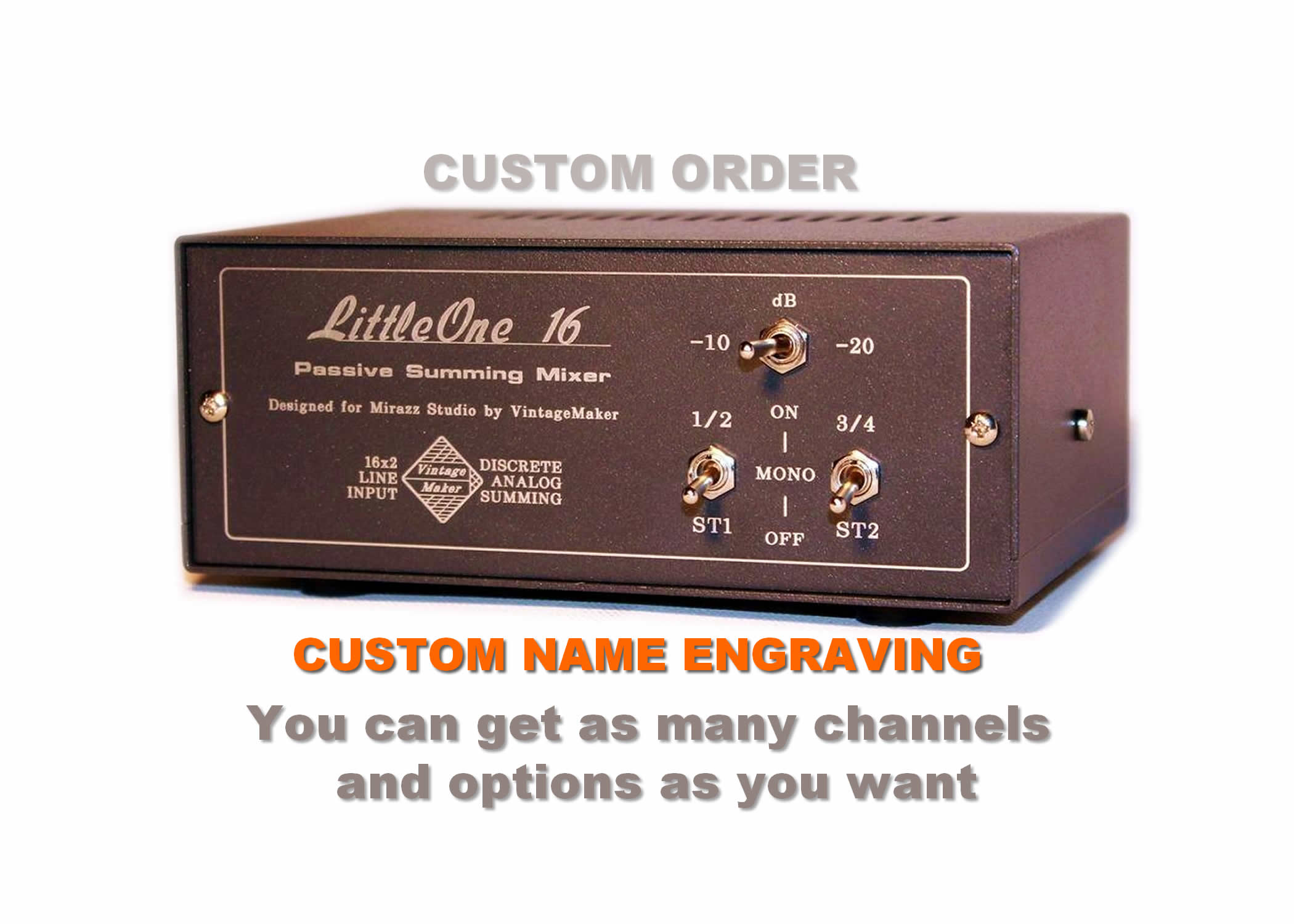
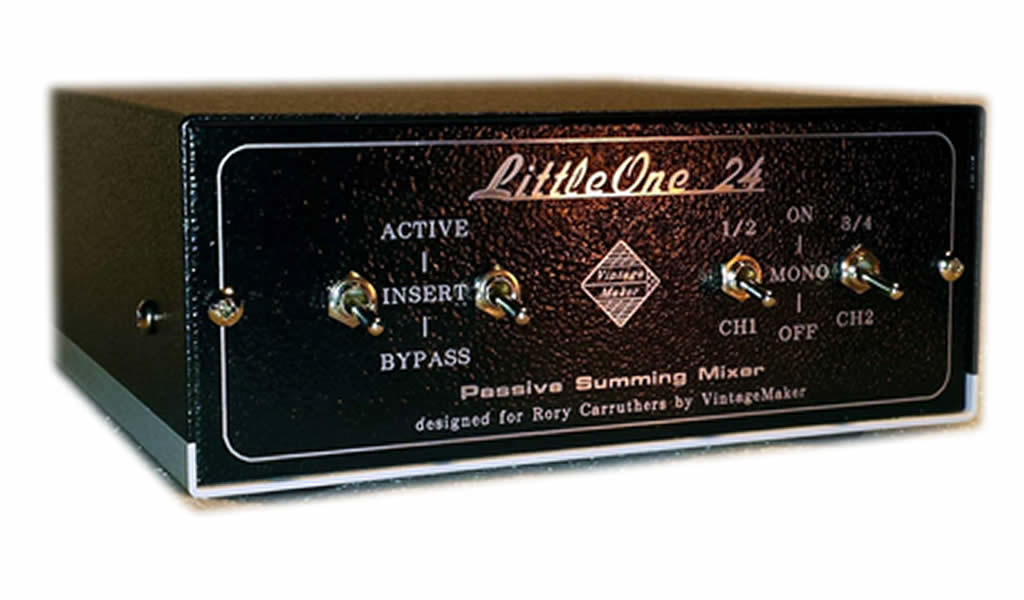
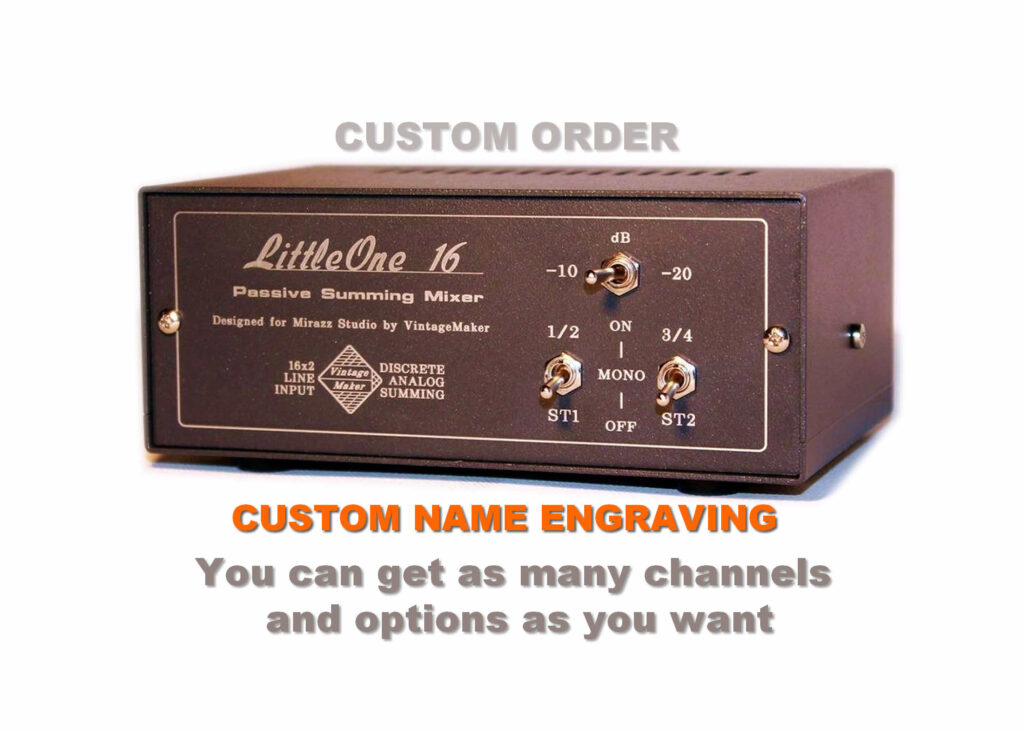
| Mono Function | Optional per-channel or stereo-to-mono switching |
| Variable Headroom Gain Switch | Selectable configurations: -6/-16 dB, -10/-20 dB, or -15/-25 dB |
| Summing Bus Attenuation | Available in -6, -10, -15, -20, or -25 dB steps |
| Power | Fully passive – no external power required |
| Format | Desktop – 150 × 60 × 100 mm (5.9 × 2.4 × 3.9 in) |
| Build Time | 10–16 working days after configuration approval |
| Origin | Handcrafted in EU since 2010 – worldwide shipping |
Why Analog Summing Improves with Higher Channel Count
At 16–24 channels, the analog bus carries more simultaneous voltage interactions than at any lower channel count. This is where passive analog summing delivers its most pronounced effect — wider stereo field, instruments remain separated and focused, and a dimensional depth that grows with every additional channel feeding the bus.

Built for Advanced Hybrid Workflows
The LittleOne 16–24 is ideal for:
- Extensive DAW stem sessions with 16+ outputs from your audio interface
- Hardware-heavy studios with complex synth and outboard routing
- Multi-output drum machines (Elektron Analog Rytm, Roland TR‑8S, Akai MPC) feeding separate channels to the summing bus
- Dense electronic or orchestral productions with multiple parallel layers
- Parallel compression chains summed into analog for cohesion
- Pre-mastering analog summing to glue the mix before the final chain
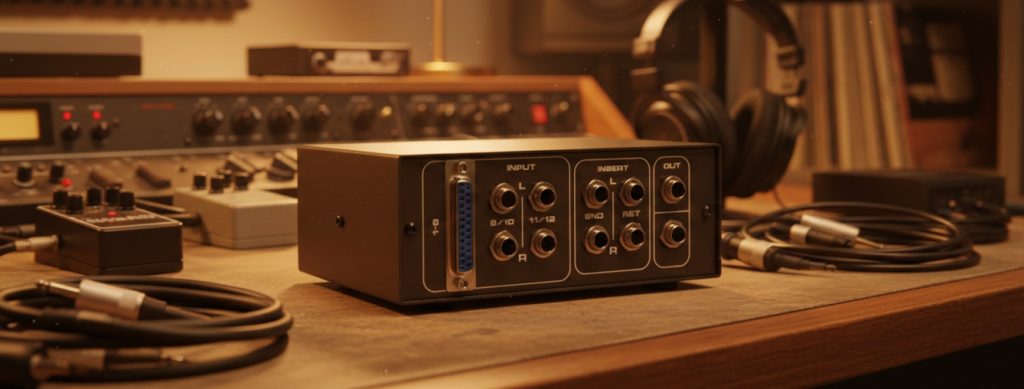
Compatible Interfaces
The LittleOne 16–24 works with any audio interface that has balanced outputs. Here are some common examples — but it will work with most professional interfaces:
- Antelope Orion 32, Orion 32+, Galaxy 32 – primary target for 24-channel setups
- RME Fireface UFX II, UFX III, Fireface 802 FS
- Universal Audio Apollo x16, Apollo x8p
- MOTU 16A, 24Ai, 112D, Pro Audio
- Focusrite Red 8Line, Clarett+ 8Pre (with expander)
- Prism Sound Atlas, ADA-8XR
- Steinberg AXR4T, Behringer ADA8200 (stacked)
Important: Provide your exact interface model when ordering. Each LittleOne 16–24 is custom-built for your interface — not a generic specification.
What Engineers Say
“I was used to mixing in the box and always fighting for space with 16+ tracks no matter what I did, the mix would collapse after the DAW bounce. I had read a lot about summing but was skeptical. Then the LittleOne 16 changed that immediately, the mix opened up, instruments found their own positions, and I stopped reaching for width plugins. It sounds like a record now.”– Marcus Hill
“Right away I noticed more roundness and depth compared to bouncing in the DAW, reverb tails had more detail, which made finalizing mixes easier and the flexibility of running the output through different preamps is a real bonus I’ve been using it with a Neve 1078 clone and an ART Pro preamp.” – Peter Cruz
“The difference compared to my old mixer is huge the LittleOne has noticeably more punch and detail and everything sounds bigger and wider and with less preamp gain does more. And the price to quality ratio is honestly crazy good. Highly recommended.” -Daniel Marsh
“My LittleOne 16 with the dual mono switches made an immediately noticeable difference, and my mixes sound clearer, wider, and more focused, with much better instrument separation. I think it is due to headroom, I don’t even need to use a limiter plugin in the DAW. On top of that, the unit is impressively quiet. The overall result is more open and three-dimensional compared to mixing entirely in the box..” – Jason Merrill
When Analog Summing May Not Be Needed
Single stereo (L/R signal) sessions receive zero benefit from passive summing – the bus interaction that creates analog depth and cohesion only occurs when multiple channels are active simultaneously. From 4 channels upward, the effect becomes audible. At 16–24 channels, it is at its most pronounced.
For single-source processing, a transformer-based color amplifier is a better fit. → Explore the Transformer Color Amp
Frequently Asked Questions – LittleOne 16–24
Do I need additional gain stages or external preamps?
No. The mic preamps built into your audio interface provide enough gain for normal operation. The LittleOne 16 is calibrated to match your interface’s output level and the usable gain range of its preamps, so the passive attenuation is recovered cleanly.
How does the LittleOne 16–24 compare to the LittleOne Wide (8–16 ch)?
Both use the same architecture and custom calibration. The Wide is designed for mid-sized sessions with 8–16 channels, while the 16–24 excels in larger sessions where analog summing has the most impact. If you regularly work with 16+ stems or outputs, the 16–24 is the right choice.
What if I only use 10 channels out of 16?
No problem. The LittleOne 16–24 performs perfectly even when not all inputs are used. There’s no loss of quality, added noise, or reduction in depth or stereo imaging when using fewer channels.
Does more channels mean more noise?
No. The passive resistor network adds no active circuit noise. Overall system noise depends on source signal quality, cable integrity, interface grounding, and the characteristics of any external preamps used for makeup gain. A properly gain-staged, well-grounded 24-channel session performs within the same noise floor as an 8-channel session from the same interface.
How should I set my levels?
Start with DAW stem outputs peaking around -18 dBFS. Gradually increase levels until the mix gains depth and cohesion without losing transient punch. With 16+ channels, levels add up faster — use the PAD switch if signals run hot.
Which interface works best for 24-channel setups?
Any interface with 24 balanced outputs will work. Popular choices include the Antelope Orion 32 and RME Fireface UFX III. Provide your exact interface model when ordering — each LittleOne 16–24 is calibrated specifically for it.
What cables are required to connect the LittleOne 16–24 Summing?
The LittleOne 16–24 Summing can be ordered with TRS 1/4″, XLR, or D-Sub DB-25 connectors depending on the configuration selected at the time of ordering; for 16–24 channel setups DB-25 connections are typically the most practical solution for clean multi-channel cable management, and while the unit accepts both balanced and unbalanced sources, balanced connections are recommended for optimal noise rejection and signal integrity.
How long does production and delivery take?
Typical build time is 10–16 business days once the configuration is finalized; each unit is assembled and calibrated to order rather than kept in stock, and if you need it sooner, expedited build options may be available on request.
Which interface works best for 24-channel setups?
Any interface with 24 balanced outputs will work. Popular choices include the Antelope Orion 32 and RME Fireface UFX III. Provide your exact interface model when ordering — each LittleOne 16–24 is calibrated specifically for it.
What cables do I need to connect the LittleOne 16–24 summing?
The LittleOne 16–24 summing accepts TRS 1/4″, XLR, or D-Sub DB-25 connections depending on the connector configuration chosen at order. For 16–24 channel setups, D-Sub DB-25 is the most practical option for clean multi-channel cable management. Both balanced and unbalanced sources are accepted — balanced operation is recommended for optimal noise rejection.
Technical Summary & Performance Specs
The LittleOne 16–24 is engineered for uncompromised signal integrity. The Floating Differential Bus architecture ensures a ground-independent summing environment, preserving the phase relationship of your stems across all channels.
- Custom Impedance Matching: Every unit is resistor-calculated to match your specific interface I/Os for optimal gain staging and lowest noise floor.
- Precision Components: Built with precision-selected Vishay Dale resistors at 0.1% matching accuracy across the stereo field.
- Flexible Scalability: Available in 16, 18, 20, 22, and 24 channel configurations with consistent performance across all inputs.
- Passive Signal Path: No active components — final sonic character is determined by your chosen makeup gain stage.
Order & Configuration
Gallery