
Analog Headroom Explained: Why Headroom Is Meant to Be Used, Not Avoided
This article is the deep-dive technical reference on analog headroom. For a complete introduction to analog summing and how headroom fits into the overall workflow, start with: How Analog Summing Creates Depth, Warmth & Headroom →
In modern digital workflows, headroom is often treated as a safety margin — something to preserve, protect, and never touch. In analog audio, the opposite is true. Analog headroom is not just space before distortion. It is where tone, depth, and musicality are born. Understanding how analog headroom works — and how to drive it intentionally — is one of the key differences between a clean mix and a mix that feels alive.
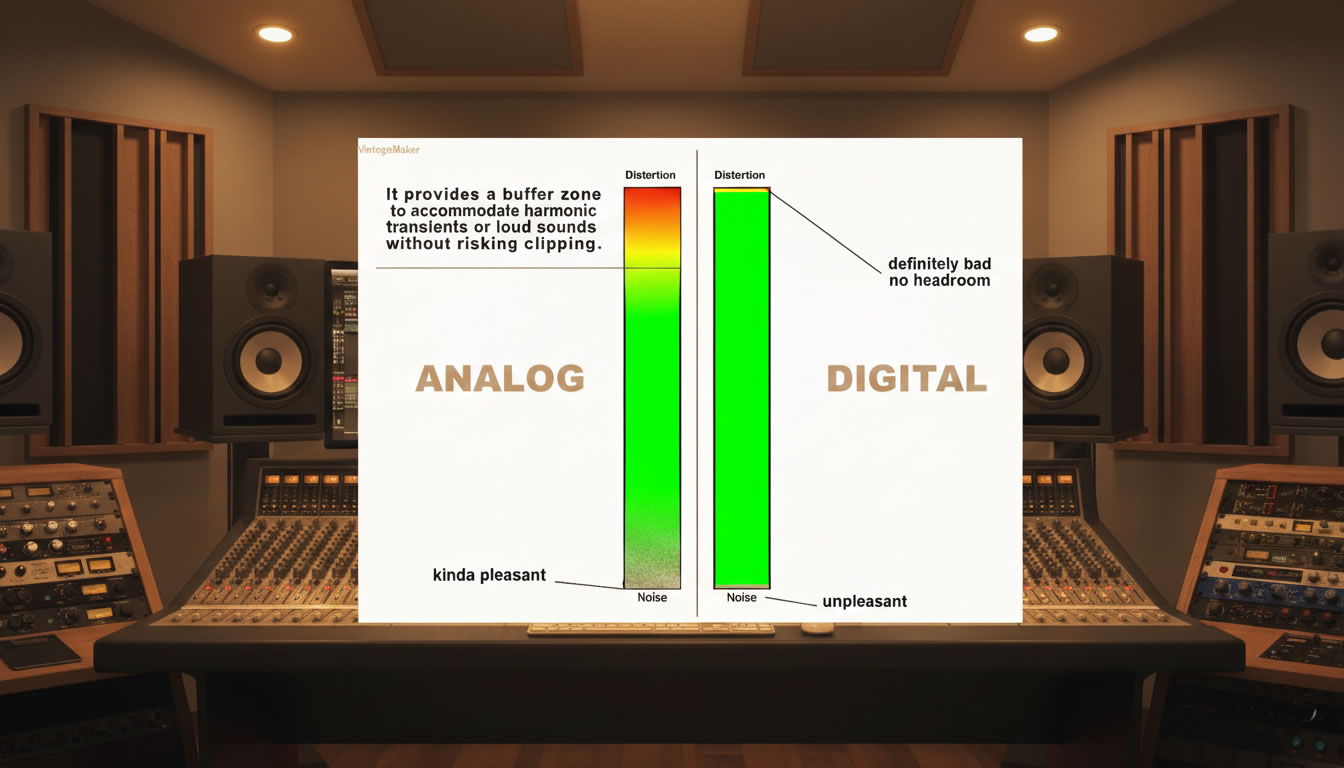
What Is Analog Headroom, Really?
Analog headroom is the level range between a circuit’s nominal operating level and the point of hard clipping. But unlike digital systems, analog circuits do not suddenly break at the top. Instead, as level increases:
- Linear behavior slowly transitions into nonlinear behavior.
- Harmonic content appears gradually.
- Saturation develops in layers.
This means analog headroom is usable, not forbidden.
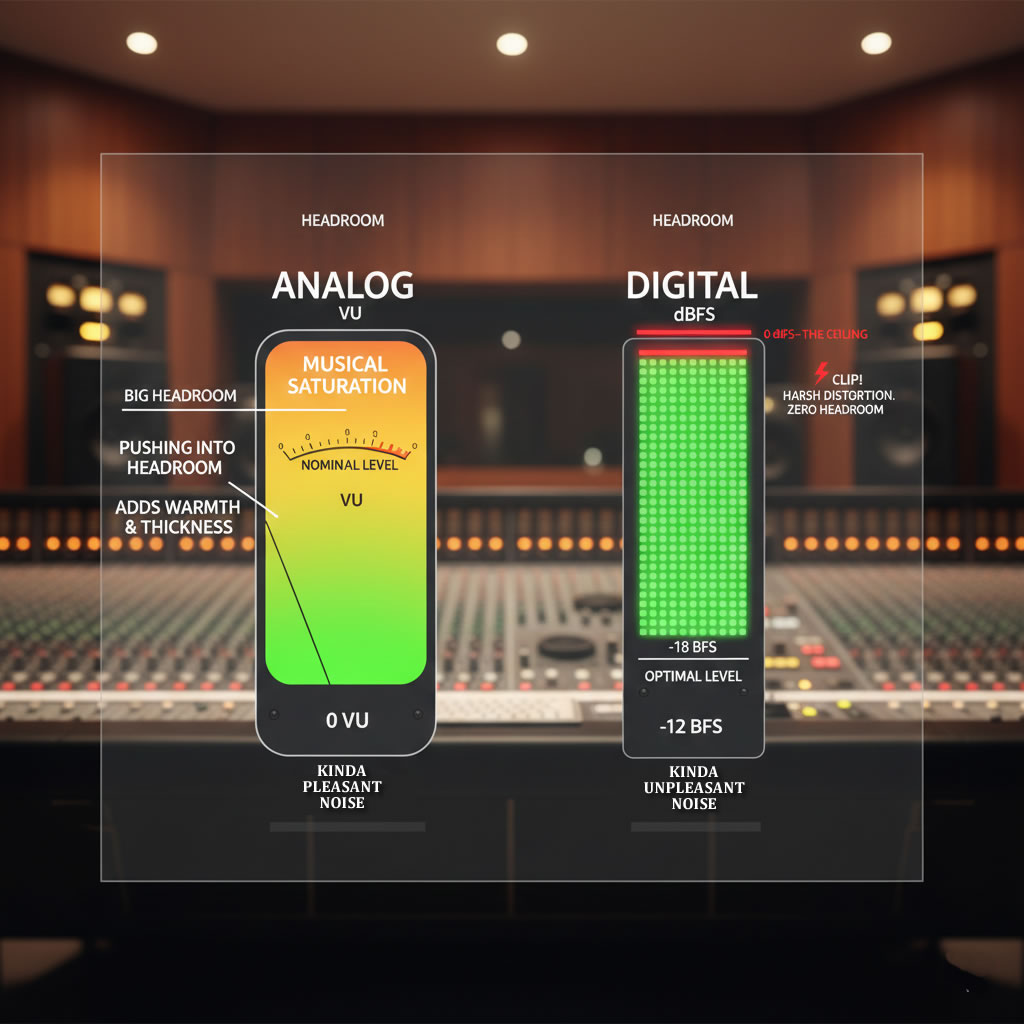
Headroom: More Than a Safety Margin — The Analog Advantage
In digital audio, 0 dBFS is the absolute limit. Go past it, and the signal clips instantly — like hitting a brick wall. There’s no warning, no gentle transition.
Analog audio works differently. The “nominal” level is just a reference point, not a hard limit. Push the signal higher, and the circuit responds naturally: first you get subtle saturation, then gentle compression, and only later more noticeable distortion. This gradual behavior is what makes analog forgiving and musical.
In short: digital headroom protects your signal from breaking. Analog headroom shapes the sound as you push it. This is why analog summing and mixing often sound bigger, fuller, and more dynamic — not because it’s louder, but because the circuit “fails gracefully,” adding harmonics, density, and a pleasing musical character instead of harsh clipping.
Digital vs. Analog Headroom: The Numbers
Analog summing adds real headroom and subtle component interaction, giving mixes extra depth, density, and dimension compared to perfectly linear digital summing.
| Parameter | Digital (DAW, 32-bit float mix bus) | Analog Summing (VintageMaker) |
|---|---|---|
| Nominal Operating Level | Typically aligned so that 0 VU ≈ −18 dBFS | +4 dBu (professional studio reference) |
| Maximum Level | 0 dBFS at converter stage | +22 to +24 dBu (circuit-dependent) |
| Practical Headroom | 0 dBFS (hard ceiling) limited at D/A stage | ~18–20 dB of real analog voltage headroom |
| Behavior at Limit | Hard clipping at converter stage | Gradual saturation, level-dependent behavior |
| Linearity | Mathematically perfect summing | Real-world component interaction – soft saturation |
| Sonic Result | Transparent and precise | Subtle depth, dimensionality, and tone shaping |
| Creative Use of Level | Keep peaks below 0 dBFS | Headroom can be used creatively for density and impact |
dBFS vs. dBu: Why the Confusion Exists
Much of the confusion around analog headroom comes from mixing digital and analog measurement concepts. These are not interchangeable:
- dBFS (decibels Full Scale): a digital reference where 0 dBFS is the absolute maximum. All signal levels are expressed as negative values below this ceiling. For example, −18 dBFS means the signal is 18 dB below the digital limit.
- dBu (decibels unloaded): an analog reference based on 0.775 V RMS. Professional analog equipment typically operates at a nominal level of +4 dBu, with maximum outputs often around +22 to +24 dBu.
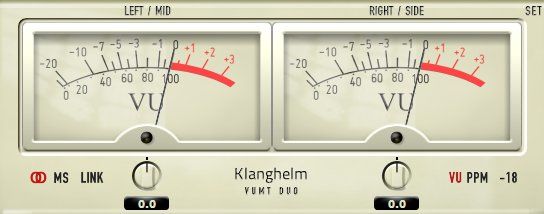
The calibration point between the two: −18 dBFS = 0 VU = +4 dBu. This is the optimal operating level for most analog summing circuits. At this point, you still have roughly 18–20 dB of analog headroom before reaching the output limit.
This is why digital meters don’t show harmonic development — they indicate signal level, not how the analog circuit responds. Even at −10 dBFS, an analog circuit can have plenty of remaining headroom. The meter tells you nothing about the actual circuit behavior.
Passive Summing and Level-Dependent Tone
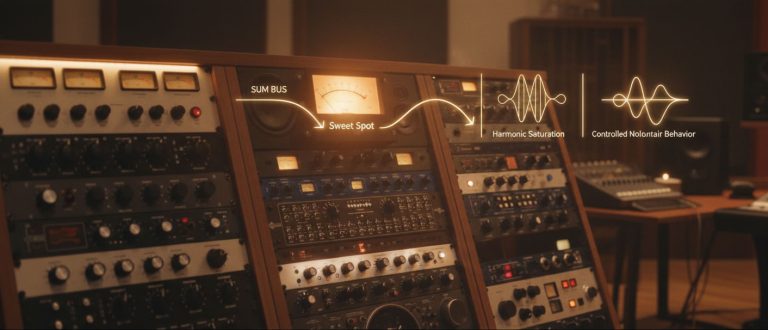
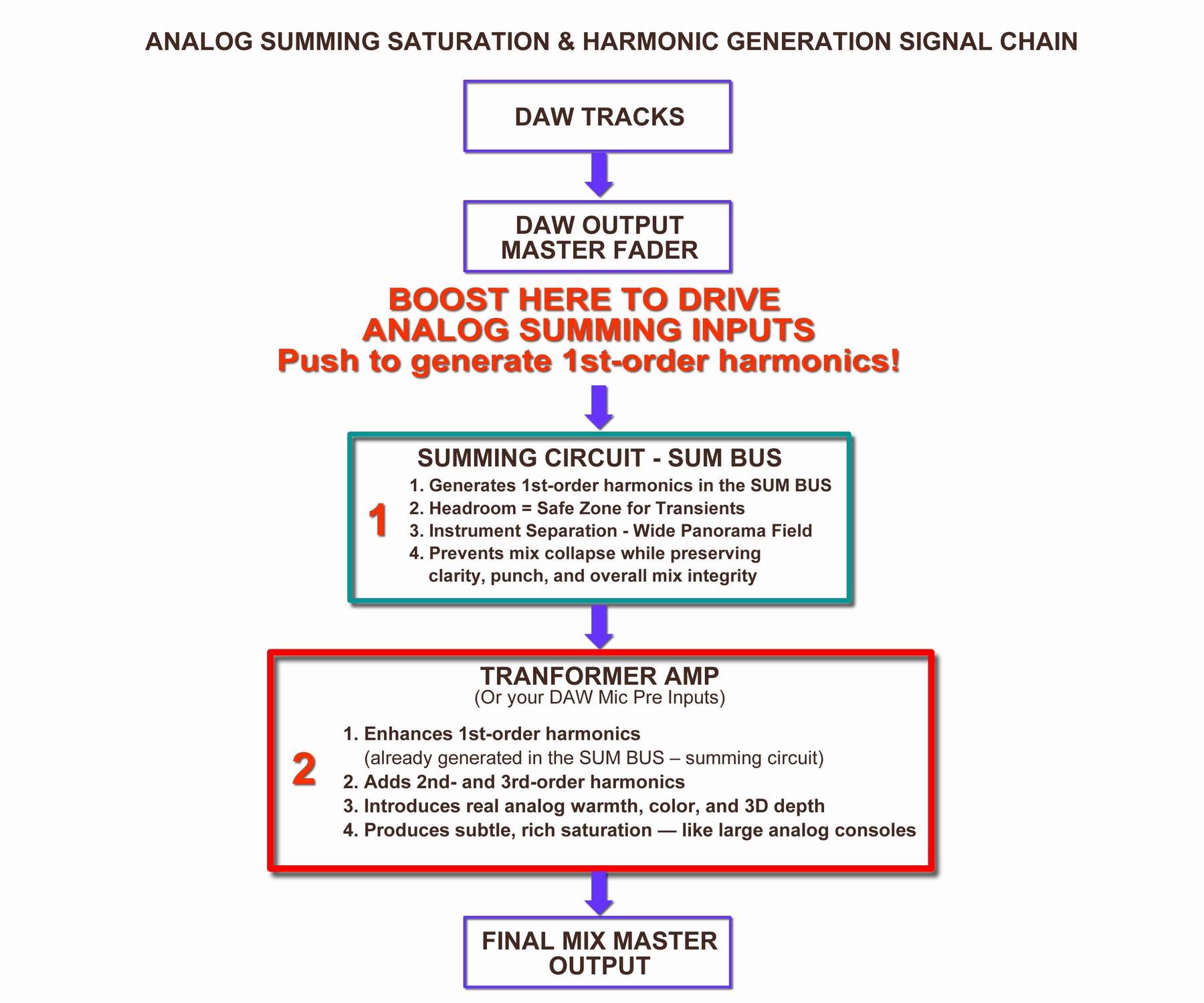
In passive summing systems, multiple channels are combined through a resistor network (SUM BUS). As signal level increases, the summing network begins to exhibit subtle electrical saturation, producing:
⦁ Low-order harmonic content
⦁ Increased perceived depth
⦁ Improved stereo cohesion
⦁ Increased instrument separation
⦁ Greater tonal density
Importantly, this is not clipping. It is controlled nonlinear behavior that depends directly on level. The summing bus itself becomes part of the sound.
For the complete technical explanation of how harmonics are generated inside the summing bus and in amplification stages, see: How Analog Summing Creates Warmth and Harmonics →

Headroom Behavior by Circuit Type
| Circuit Type | Headroom | Saturation Character | Best For |
|---|---|---|---|
| Passive Resistor Network | 18–20 dB above +4 dBu | Very gentle 2nd-order, gradual onset | Transparent summing with subtle harmonic texture |
| Active (Internal Amp) | 15–18 dB typical | Tighter, controlled character | Consistent color without external preamps |
| Transformer-Coupled Output | 12–18 dB, circuit-dependent | Rich 2nd/3rd-order, musically complex | Classic console-style harmonic density and warmth |
| VCA Amplifier Stage | 14–18 dB typical | Symmetrical 2nd+3rd, faster onset | Punchy, forward character when driven |
Gain Staging as a Creative Tool
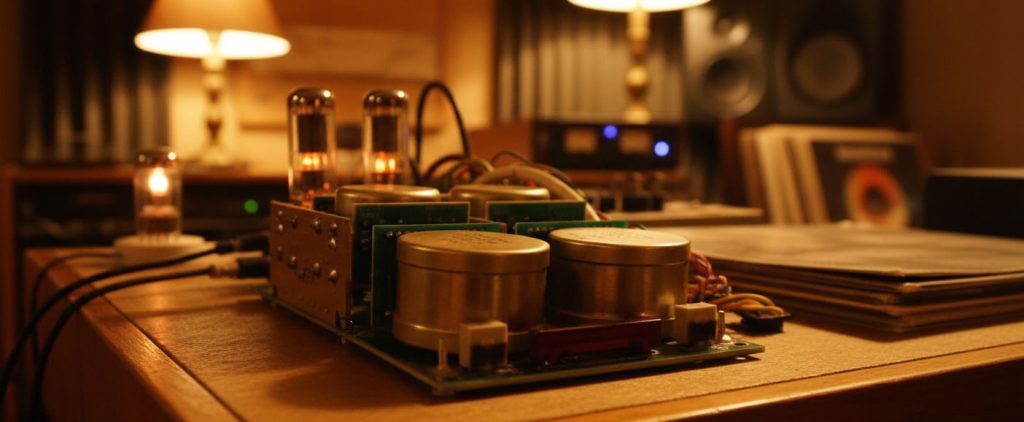
IIn analog workflows, gain staging is not just about avoiding problems — it’s about finding the sweet spot. By increasing DAW output levels into analog summing, harmonics begin to appear, depth perception increases, the stereo image opens, and the mix feels more “finished”.
Push too little, and the system stays flat. Push too much, and clarity suffers. The art lies in driving the headroom just enough.
The Golden Rule: Aim for DAW peaks at -18 dBFS to -12 dBFS = 0 VU = +4 dBu at the analog input. Push slightly hotter to activate the sweet spot. Pull back if clarity suffers.
For a step-by-step practical guide to gain staging an analog summing setup — including stem preparation, panning, and common mistakes — see: The Human Factor in Analog Summing →
Why Analog Headroom Sounds Musical
Analog distortion develops gradually as signal levels approach circuit limits, and its harmonic content varies with frequency and amplitude. This controlled, level-dependent saturation can add perceived warmth and density without harsh clipping, preserving transient detail and enhancing spatial perception. The result is a mix that may feel more open, dynamic, and three-dimensional compared to purely linear digital summing.

Final Thought
Analog headroom is not empty space; it is creative space. When used intentionally, it transforms gain staging from a technical chore into a musical decision. That is the philosophy behind true analog workflows — and the heart of the VintageMaker sound.
FAQ: Analog vs Digital Headroom
What is the difference between digital and analog headroom?
Digital headroom is a strict ceiling at 0 dBFS — exceeding it causes immediate, harsh clipping. Analog headroom is a reference level that can be exceeded safely, allowing gradual saturation and harmonic development for musical character.
Why is analog headroom more forgiving than digital?
Analog systems transition gradually into non-linearity — first subtle saturation, then gentle compression, and only later distortion. This allows signals to “fail gracefully,” producing warmth and depth instead of harsh digital artifacts.
What is -18 dBFS and why does it matter for analog summing?
-18 dBFS corresponds to 0 VU and +4 dBu in the analog domain. At this nominal level, most professional analog circuits have ~18–20 dB of headroom before reaching their output maximum. This gives you optimal room to drive the circuit and extract subtle harmonic character — the ideal starting point for analog summing.
How does gain staging work as a creative tool?
Proper gain staging determines how much the passive summing bus is driven. Increasing DAW output into the analog system produces harmonics, opens the stereo image, and makes the mix feel more finished. Pushing too little keeps the sound flat; pushing too much reduces clarity.
Why is analog headroom often misunderstood?
dBFS is not the same as dBu, digital meters don’t show harmonic development, and “leave headroom” advice is often misapplied to the analog domain. Analog systems are designed to be driven and respond musically, unlike digital systems.
Can analog summing improve stereo imaging and tonal density?
Yes. The physical interaction of channels creates clearer instrument separation, a wider stereo image, and a richer, more cohesive tonal field than digital summing alone.
Explore our 500+ custom studio gear collection and find the perfect analog summing mixer, color amp, mastering insert switch or monitor controller, and other gear for your studio setup.