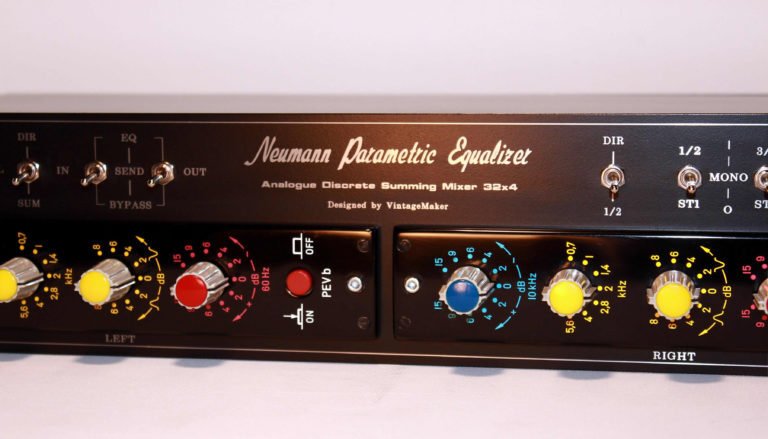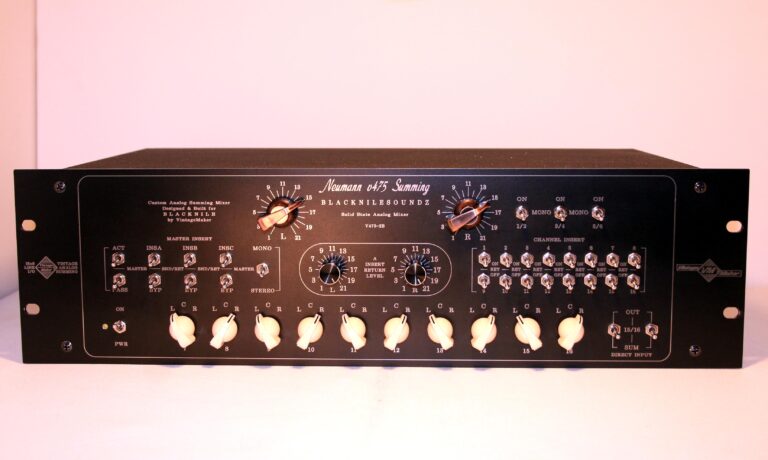

What Does an Analog Summing Mixer Do? (The Honest Answer)
Do I Need Analog Summing?
If you want to sound professional — the answer is YES.
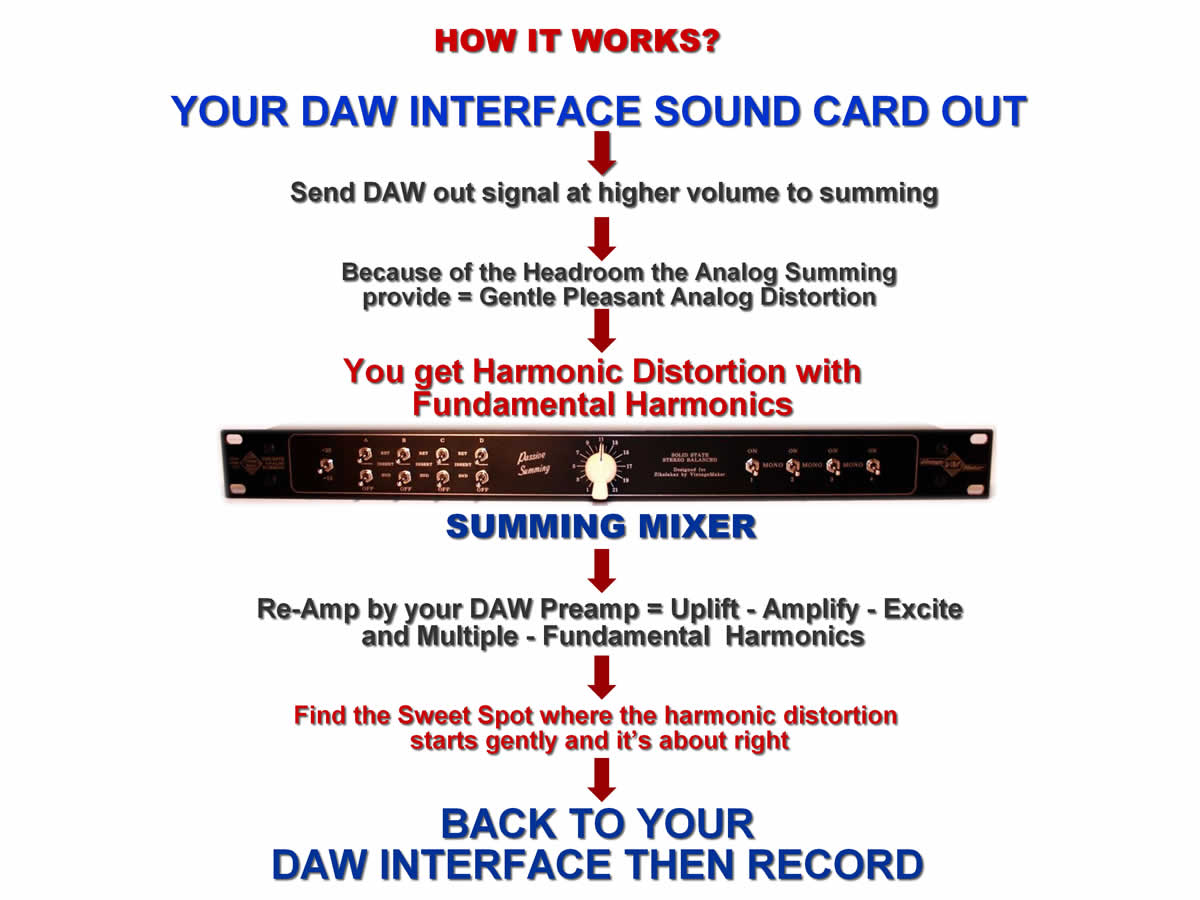
Main rule: Send your tracks louder into the summing mixer until you hear a smooth, pleasant analog warmth.
Get that big, warm, no-compromise professional studio sound with VintageMaker’s custom analog summing mixers – real analog warmth, deep stereo imaging, and rich harmonics in a compact, affordable design tailored to your setup, all at an affordable price.
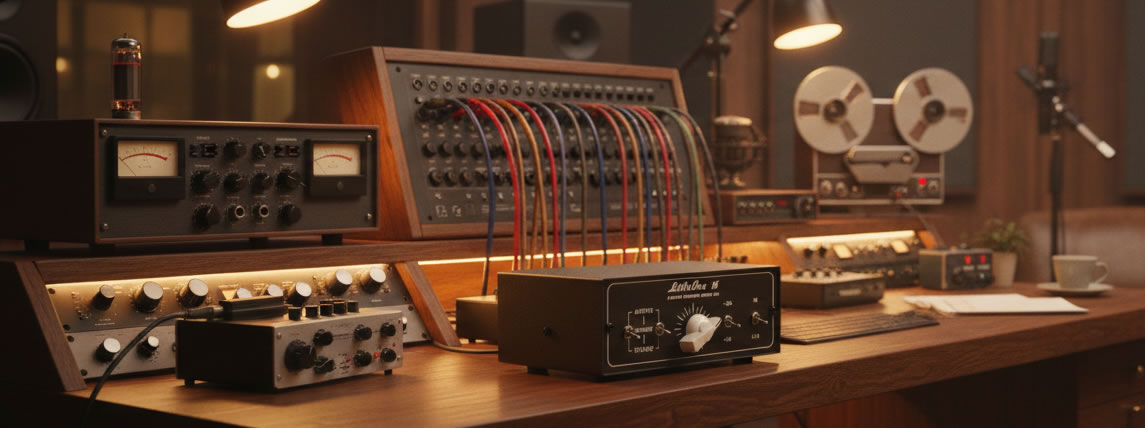
Why should I use an analog summing mixer instead of mixing entirely in the DAW?
- Big studio sound — in your own studio: get the depth, width, and analog warmth of legendary mixing consoles.
- Sound like a pro: impress your listeners with rich, polished mixes that stand out.
- No harsh digital edges — no flat, lifeless digital sound — no computer or plugin power limits.
- Say goodbye to cold, flat ITB mixes — enjoy smooth, natural authentic analog character.
- Real analog summing — big headroom — safe transients — huge harmonic content!
- Not a plugin or emulation — these can never replicate the warmth and richness of 100% discrete analog circuitry that delivers true, big-studio 3D sound, thanks to hardware physics.
- Custom designed to fit your space, studio setup, workflow, and existing cables/connectors.
- Desktop or rack-mounted design — professional sound, compact format, available in any channel count.
- Pro-quality sound without the pro price.
The Sweet Spot: Getting Subtle Harmonic Distortion
By boosting the input gain, you introduce subtle and pleasant analog harmonic distortion. The analog summing headroom (thanks to its physics) allows space for transients and creates beneficial gentle harmonic distortion. This prevents overload and adds warmth, transparency, and more spatial depth. That’s why your music sounds “like a record” — instruments sit better in their place when run through an analog summing mixer.
Just Two key rules to remember — see Step 1 and Step 2 below and you’ll realize how easy it is! Let’s do this!
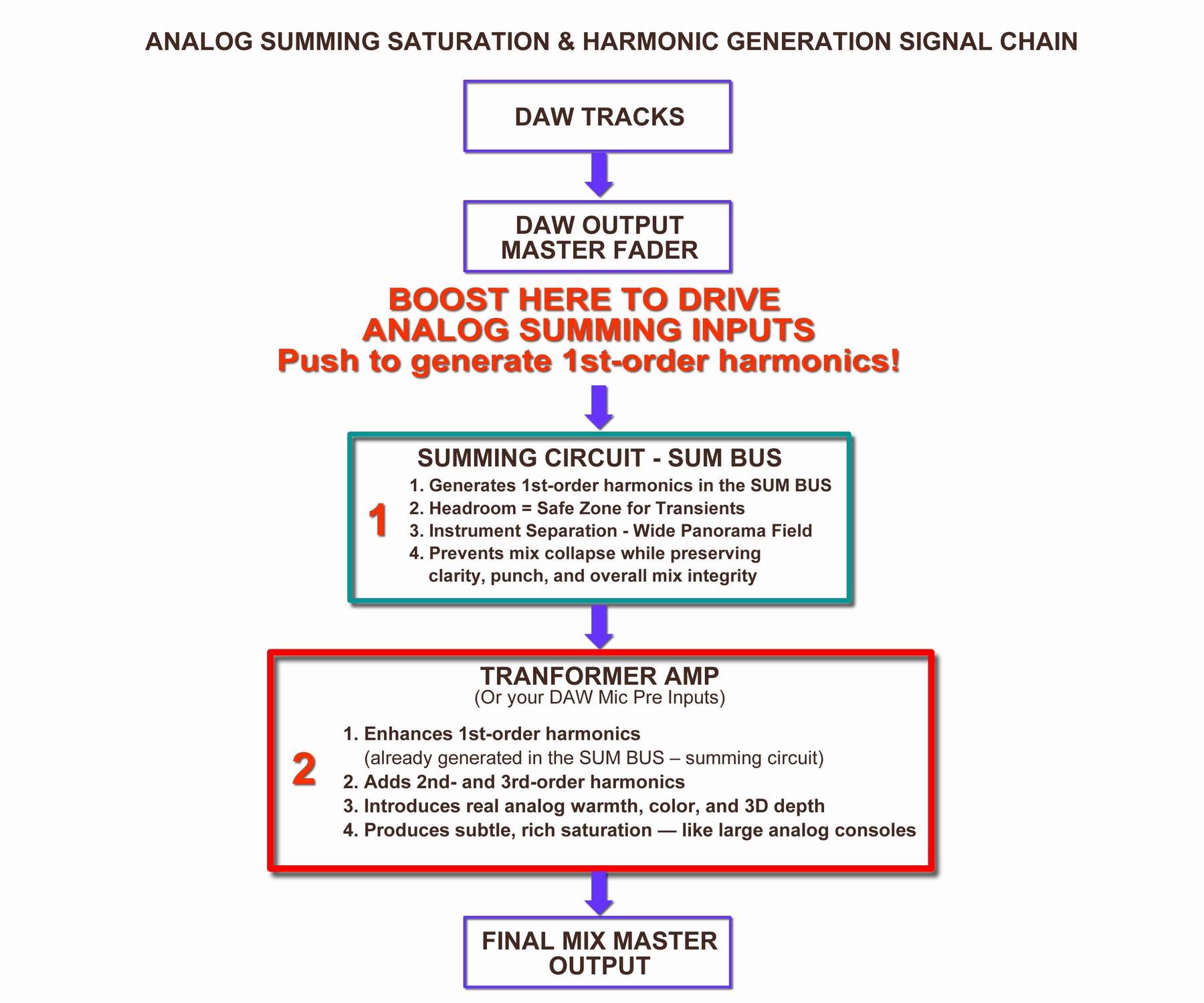
Pro tip: To get that rich, analog sound, push the instruments into the summing mixer at a high level until gentle harmonic distortion occurs.
Does Analog Summing Make a Difference?
You’ve probably asked yourself this question before; you’re not alone; thousands of others have asked it too
So, what does Analog Summing mixer do? It transforms your audio experience by combining multiple audio signals, allowing for a richer and more dynamic sound. To really grasp what does Analog Summing mixer do, consider how it processes signals differently than digital summing solutions.

Discover how Grammy Award-winning producers use the summing mixer to enhance their sound.
Short Version Answer: Simple Physics
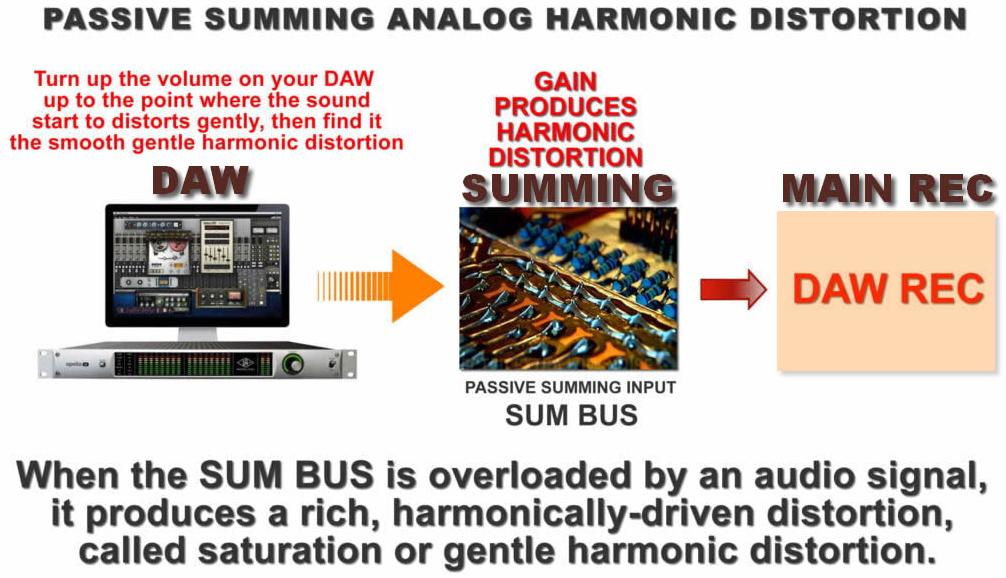
The SUM BUS – Summing Mixer Input – Internal Resistor Network – provides the SAFE ZONE called Headroom.
Headroom offers a secure – safe space for your audio material. It preserves the separate focus of the instruments and maintains their proper position in the panorama field (Wide Deep 3D Sound). Through proper gain staging (sending a higher-level audio signal to the summing inputs and then hitting or getting the gentle analog harmonic distortion), you maintain and capture the fundamental harmonics in the SUM BUS, which are then summed to a master stereo track.
For a deep technical dive into how headroom and harmonics interact, see: Analog Headroom Explained →
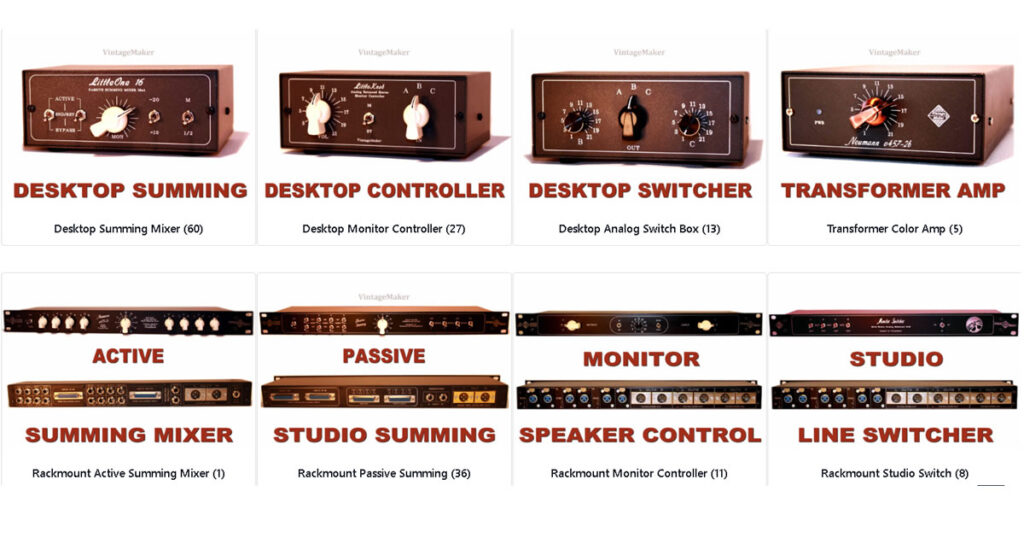
How Does Analog Summing Help You Achieve a More Professional Sound for Your Music?
- No Mix Collapse: In an analog summing mixer, your mix will never collapse. This is simple electrical physics — there’s no magic involved.
- No Digital Limitations: In the analog world, there are no 0s and 1s — only voltages. Your final mix can’t collapse, as there are no bits and bytes, no floating-point calculations, just voltage elements with rich harmonic transients.
- More Channels = More Depth: The more channels you use in analog summing — whether 4, 8, 16, 32, or even 48 or 96 — the more space and depth you gain in your music. This results in a final mix that sounds wider, deeper in 3D, with improved instrument separation and higher resolution.
How Does an Analog Summing Mixer Sound Different From Digital?
An analog summing mixer transforms your audio experience by combining multiple audio signals as real electrical voltages, allowing for a richer and more dynamic sound — something no digital algorithm can fully replicate. While digital mixing adds sample values with mathematical precision, an analog summing mixer introduces subtle electrical interactions that affect phase, dynamics, harmonic structure, and spatial perception. This is the foundation of what engineers describe as depth, width, and analog warmth.
For a full comparison of digital vs. analog summing signal behavior, see our complete guide: How Analog Summing Creates Depth, Warmth & Headroom →

Amplifying Harmonics: The VCA Amplifier Effect
Pass your summed signal through your DAW interface preamp or a transformer amp. Here, the VCA amplifier uplifts and boosts fundamental harmonics (which were created in the sum bus) and introduces additional excitement and saturation, enhancing the complex harmonics and creating the warm analog color character sound.
Main Rule: Analog Separation for 3D Sound
The more channels (4, 8, 16, 32, or even up to 48 or 96) you mix in analog summing, the greater the analog separation in the panorama field, creating a wider, deeper 3D sound.
First Stage: SUM BUS — Headroom & Harmonic Distortion
The SUM BUS — summing mixer input resistor network — provides the SAFE ZONE called Headroom. The most important benefits under the protection of analog headroom:
- Maintain instrument integrity and separation in the panorama field
- Prevent mix collapse, maintaining harmonics, transients, and saturation
- Generate fundamental gentle analog harmonic distortion
Analog summing has no input limit — it can easily sum together 8, 16, 32, 64 up to 96 input channels. There are no floating-point mathematical processor calculations as in digital summing.
How to Attain Subtle Analog Harmonic Distortion
Once you’ve found the right placement for your instruments in the panorama field, gently begin to increase the volume of the main instruments — or the whole mix simultaneously — until you hear them filling the space. Find the point where the harmonic distortion just begins to emerge. Simply boost your DAW output level (master fader), and you’ll get some pleasant, gentle distortion as you drive the SUMMING INPUTS (SUM BUS) above its nominal level and find the “Sweet Spot.”

Second Stage: Gain Staging After the Sum Bus
Gain staging is the process of making sure the audio volume is set to an optimal level for the next processor in the chain. You should find the maximum volume that your DAW interface or mic preamp input can handle without distortion, typically in increments of 0.1–0.2 dB, to get the best setting.
For a complete step-by-step gain staging guide specific to analog summing, see: How Analog Summing Creates Warmth and Harmonics →
How Can I Get It?
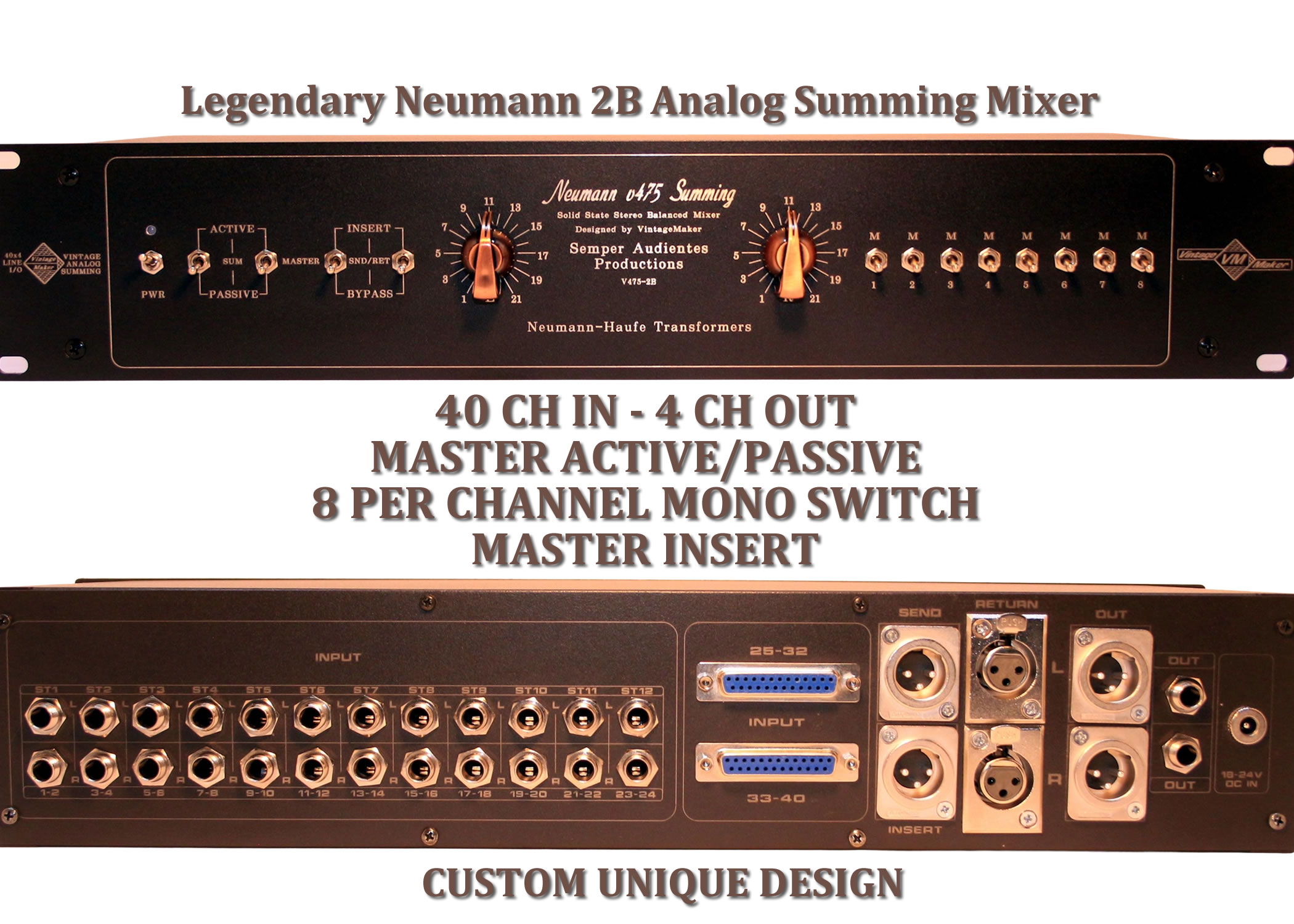
You can use your DAW interface’s Mic Preamp or transformer amp/amplifier to boost the signal on the summing outputs; you can also use your line-level inputs on your audio interface, your outboard preamps, or internal transformer amp (Active summing like Neumann), each providing a different color.
Amplifying Harmonics and Adding Excitement
With signal amplification, you achieve:
- Harmonics amplification — amplifying the fundamental harmonics generated on passive summing inputs.
- Excite and add harmonics — creating both even and odd harmonics using a transformer pre-amp or tube amp.
Pre-amp Plugin Emulations: Many clients have achieved excellent results with UAD Apollo Unison preamps. These pre-amp emulations deliver outstanding results that can be surprisingly close to hardware on first listen.
Pro Tip: Push the instruments into the summing mixer at a higher level until you start hearing a subtle harmonic distortion. This will add warmth, depth, and better separation to your mix, giving it a more professional, polished sound — just like a finished record.
Once you’ve found the right placement — location for your instruments in the panorama field (where they sit better), you gently begin to increase step by step the volume of the main instruments or what you want to highlight — or make it more focused — is like pulling the focus of a camera lens (or on all tracks / increase the volume of the whole mix simultaneously) until you hear them filling the space (without overpowering the surrounding instruments). Finally, find the point where the harmonic distortion just begins or starts to come into existence.